The Laoag Clergy

NEW BLOGSITE!

Visit St. Anthony of Padua Parish, Marcos, Ilocos Norte.

The CHRONOS: Monthly Diocesan Schedule for FEBRUARY 2009

July 26: Laoag's foundation anniversary and St. Anne Parish fiesta

Today, the Diocese of Laoag celebrates her 48th birthday. Today, too, is the launching of activities in commemoration of the diocese's golden anniversary in 2011.

Let us pray for our diocese. Let us pray for the increase of faith and the deepening of love and commitment to God and the Church.

Happy fiesta to the Piddiguenos!

Click here to read CBCP news on the launching.

July 25: Fiesta greetings!

Today is the feast of St. James the Greater.

Happy fiesta to our brothers and sisters in Solsona and Pasuquin!

Cadaratan Church: A Miracle in Progress

Cadaratan Church: A Miracle in Progress


The Dream Church of Our Lady of Fatima Parish, Cadaratan, Bacarra, Ilocos Norte

The Dream Church of Our Lady of Fatima Parish, Cadaratan, Bacarra, Ilocos Norte

Foundation for the church-construction project in Cadaratan, Bacarra put up!

The construction of the OUR LADY OF FATIMA PARISH CHURCH started anew, September 8, the birthday of Mama Mary. Very crucial in this project is the financial consideration being tacked by the whole parish community. To address this concern, we, the Parish Pastoral and Finance Councils, together with our newly-appointed parish priest, Rev. Leonardo L. Ruiz, planned to put up a FOUNDATION for the continuation and completion of the construction of the parish church.

The Foundation is chaired by our beloved Bishop, Most Rev. Sergio L. Utleg, D.D. and the members of the Board include Victor R. Bolosan, M.D., Rosalina R. Javier, Flordelina T. Cadelina, Eugenia M. Mendoza, Emilia B. Agonoy and Dante Subia, all from Our Lady of Fatima Parish.

Registration of the Foundation with the Securities and Exchange Commission (SEC) is under way.

Architects and Engineer: Arch. Coleen Cajigal and Arch. Joemar Bolosan, Engr. Eduardo Cid.

FINANCIAL ASSISTANCE IS NEEDED. For those who wish to send their donations directly through the bank, this is our bank: PHILIPPINE NATIONAL BANK, Batac Branch, Batac, Ilocos Norte, Philippines. DOLLAR ACCOUNT NUMBER: 158881300038; Account Name, Most Rev. Sergio L. Utleg, D.D., Victor R. Bolosan, M.D. and Flordelina T. Cadelina. PESO CHECKING ACCOUNT: 158881300020, with the same above-mentioned account name.

The Happy Priests

The Happy Priests
The clergy during their annual retreat with Bp. Mylo Vergara of the Diocese of San Jose, Nueva Ecija as retreat master at Betania Retreat House in Baguio City, November 10-13

HELP BUILD THE CHURCHES OF OUR YOUNG PARISHES!

ST. JOHN BOSCO (BARESBES, DINGRAS)
ST. JOSEPH THE WORKER (CARASI)
ST. FRANCIS OF ASSISI (DAVILA, PASUQUIN)
OUR LADY OF FATIMA (CADARATAN, BACARRA)
ST. ROSE (STA. ROSA, SARRAT)

OUR MOTHER OF PERPETUAL HELP (PANCIAN, PAGUDPUD)

For financial assistance or donations in-kind, please contact the Bishop or the Curia at (077)770-5210, or Fr. Lorenzo Torreflores (Baresbes, Dingras) at 0917-5701085, Fr. Danny Devaras (Carasi) at 0920-5537806, Fr. Lester Menor (Davila, Pasuquin) at 0915-7879701, Fr. Leo Ruiz (Cadaratan, Bacarra) at (077)670-3801, and Fr. Anthony Dimagiba (Sta. Rosa, Sarrat) at (077)782-2031, Fr. Antonio Calautit, SVD (Pancian, Pagudpud) at 0918-5228902.


Listen to DZEA-CMN Radio Totoo, 909 khz!

Pray for your priests. They need your prayers as much as you need theirs.

Pray for your priests. They need your prayers as much as you need theirs.
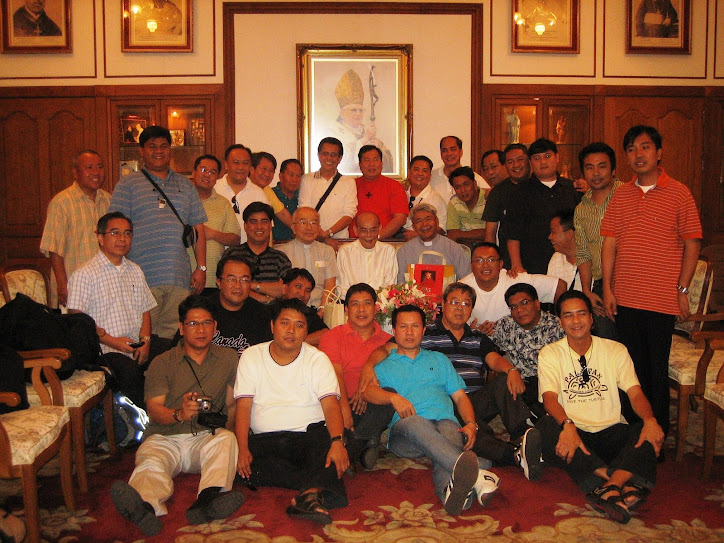
The clergy of Laoag with the lone cardinal of Thailand and the bishop of Changmai
Showing posts with label The Bishop. Show all posts

Pastoral Letter No. 1, Series of 2009

Patpatgek a Kakabsatko ken Cristo,

Domingo ita nga aldaw, ngem iti liturhiyatayo, yantangay addatayo iti Tawen ni San Pablo, rambakantayo ti Fiesta ti Panagbabawina. Napinget idi un-unana a namarparigat ken nangidadanes kadagidi immuna a Cristianos, ngem kalpasan ti panagbalbaliwna naglatak kas Apostol kadagiti Nasiones. Isu ti nangbangon kadagiti adu a Nacristianoan a Kagimongan. Kadagiti sursuratna, ingunamgunamna kadagidi immuna a Cristianos nga, iti ayatda ken Cristo, agbiagda a nasantoan ken addaan gagar a mangisaknap ti Sao ti Dios. Nagbalin pay dagiti sursuratna kas bagnosda iti inaldaw-aldaw a panagbiagda ken namatibker iti pammatida a nangrakrak iti bakud iti nagbedngan iti Judio ken Gentil, tagabo ken siwawayawaya, tapno agbiag ti amin kas agkakabsat iti sidong ti maymaysa nga Ama nga isu ti Dios.

Iti pannakainspirartayo kadagiti pagpatulad ken panursuro ni San Pablo, tarigagayantayo met a pasantaken dagiti Nacristianoan a Kagimongan ken Parokia tapno ad-adda ti panagtignaytayo a mangsango kadagiti karit ken mangitungpal kadagiti ipaannong ti Pannakaisaknap ti Sao ti Dios. Daytoy ti gapuna a pabaroentayo dagiti amin a Parish Pastoral Councils (PPCs) and Parish Finance Councils (PFCs) kadagiti amin a parokia iti diocesis ita a tawen. Ammoenyo koma ngarud dagiti sumaganad:

1. Sakbay nga aggibus daytoy a bulan ti Enero, naurnos koman ti tunggal parokia ti PPC ken PFC. Siguradoak a madaman nga ileplepas ti Kura Parokoyo daytoy. Naipromulgaren ti Constitution and By-Laws of the PPC and PFC. Mangnamnamaak a naipalawag kadakayon ti proseso ti pannakapili dagiti kameng dagitoy dua a konseho.

2. Inton Pebrero 28, Sabado, iti a las 9 iti bigat, maaramidto kadagiti amin a parokia ti panagpili kadagiti agbalin nga opisial ti PPC. Dagiti laeng kameng ti PPC ti mabalin a makipaset iti panagpipili ken mabalin a maidasig kas opisial. Iti beddeng ti PFC, amin a kameng ken opisial ket pilien ti kura paroko.

3. Inton Abril 6, Lunes to Semana Santa, kalpasan ni Misa ti Crisma, maaramidto ti panagsapata dagiti baro a kameng ken opisial ti PPC ken ti PFC kadagiti amin a parokia, ket isunto metten ti opisial a rugi ti panagtakemda. Agserbidanto iti unos ti dua tawen, wenno uppat a tawen no mapilidanto manen iti maikadua a gundaway. Kalpasan ti maikadua a termino, masapul a masuktandanton.

No napilikayo kas kameng wenno opisial ti PPC wenno PFC, sipaparaburkayo koma a mangipaay iti bagiyo, oras ken pigsayo, nga agserbi kadagiti Tattao ti Dios iti parokiayo. Sirmata ti Maikadua a Vatican Council nga amin a nabuniagan makipaset ken makibinnulig iti pannakabangon ti Pagarian ti Dios ditoy daga. Babaen iti panangawatyo kadagiti annong nga italek kadakayo ti Kura Paroko ken dagiti kaparokiayo, makikaysakayo iti Biag ken Mision ni Cristo nga Apotayo.

No maorganisartayo ita a tawen dagiti komision, konseho ken Nacristianoan a Sangakaarrubaan (NASAs) kadagiti parokia, ken nabiag ken agtigtignay dagitoy, nabunganto ti pannakarambak ti Tawen ni San Pablo ti diocesistayo. Babaen ti panangibabaet ni San Pablo Apostol ken ni Maria nga Inatayo, maaramidtayo koma dagiti planotayo ken agbunga koma dagiti banogtayo tapno maidanon ti Naimbag a Damag ti Pannakaisalakan kadagiti amin a kakabsattayo kadagiti parokia.

Toy agserserbi kadakayo,

+SERGIO L. UTLEG, D.D.Obispo ti Laoag


(Mabasa kadagiti amin a misa iti Fiesta ti Panagbabawi ni San Pablo, January 25, 2009)

CONSTITUTION AND BY-LAWS of PARISH PASTORAL COUNCILS in the DIOCESE OF LAOAG

PREAMBLE

Responding to the Call of the 2nd Vatican Council and the 2nd Plenary Council of the Philippines for Communion, Participation and Co-responsibility in the Church; and desirous to realize the Commitment of the First Diocese of Laoag Plenary Assembly to renew and revitalize our Diocese toward making it a veritable Kingdom of God and a Community of Disciples of Jesus Christ; through the intercession of Mary Our Blessed Mother and St. William the Hermit our Patron Saint, we promulgate this Constitution of the Parish Pastoral Councils in the Diocese of Laoag.

ARTICLE I
Nature

Section 1. The Parish Pastoral Council (henceforth PPC) is a Representative Group of the Christian faithful of the parish that acts as the official policy-making, planning, implementing and monitoring body of the Parish.
Section 2. The PPC is an advisory and consultative body to the Parish Priest (or Pastor, henceforth PP) who has the final and accountable decision in parochial agenda in accord with the provisions of Church Law and in line with Diocesan policies and norms.

ARTICLE II

Objectives

Section 1. To draw a parish pastoral plan in line with the Diocesan Pastoral Plan.
Section 2. To approve the Budget of the Parish which is made and presented to it by the Parish Finance Council.
Section 3. To foster participation and communion among the People of God with one another in the parish and with the other Parishes in the Diocese.
Section 4. To give support to the PP and undertake any appropriate project or task given to it by the PP.

ARTICLE III
Membership

Section 1. Membership in the PPC is by:
a. Ex officio:
The PP and Parochial Vicar/s
Religious Sister (the Superior of the Community)
Principal or President of the Catholic School
b. Appointment by the PP:
One member from each of the Parish Commissions
Two Representatives of the Youth
c. Election by their own constituents
One Representative of (Mandated) Religious Organizations
One Representative of (Charismatic) Religious Movements
One Representative from each Barangay Pastoral Council. (In big parishes, there will be one representative from each Cluster of BPCs.)

ARTICLE IV
Officers

Section 1. The group of officers of the PPC shall be known as the Executive Board (henceforth EB).
Section 2. The members of the PPC shall elect among themselves, by secret ballot, the officers or members of the EB, composed of the President, Vice-President, Secretary and Treasurer. Other officers can be added to the EB (from among the members of the PPC) as deemed necessary by the PP or PPC, but they should not exceed seven in number.
Section 3. The functions of the EB are:
a. To make recommendations for the good of the parish, to be approved
by the PPC en banc.
b. To prepare the Agenda for the PPC en banc meeting. This involves prioritizing the needs of the parish.
c. To act as the Secretariat and Steering Committee of the PPC.
d. To undertake any task given to it by the PP and the PPC.
Section 4. The duties of the Officers are as follows:
a. President – presides in the PPC and EB meeting when delegated by the PP and to represent the Parish in appropriate occasions.
b. Vice-President – assumes the duties of the President in the latter’s absence.
c. Secretary – takes the minutes of meetings and keeps the records.
d. The Treasurer keeps and accounts for the funds of the PPC, but not
necessarily of the Parish.

ARTICLE IV
Term of Office

Section 1. The term of office of officers is two years, renewable for another term. No officer can serve for more than two consecutive terms. However, they are eligible again to be officers after a break in their officership.
Section 2. In case a member ceases to be a member because of resignation, incapacity or disqualification, the PP will appoint somebody from the same sector to serve out his/her unexpired term.
Section 3. Current PPC officers as of February 2009 are considered to be in their first term. Therefore, they can be reappointed or reelected for their second term during the coming election.

ARTICLE V
Qualifications

Section 1.
Only those Christian Faithful who are outstanding in the practice of the Faith in their parish, and who can commit themselves and are able to work with others, can be members of the PPC.
Section 2. No elective official in the Government from Barangay Captain upwards can be a member of the PPC, much less be an officer.
Section 3. No member of the PPC can be a member of the PFC and vice versa.

ARTICLE VI
Meetings

Section 1. The meetings of both the PPC and the Executive Board shall be presided over by the PP, although he may delegate the PPC President to preside. The PP can call a special meeting whenever he deems it necessary.
Section 2. The PPC en banc meets bi-monthly, and so does the Executive Board. Hence, their meetings alternate every month. The meetings are held on the ______ Sunday (or another day) of the month, at ______ o’clock in the Parish Hall..
Section 3. All meetings must be formal in nature, and minutes are to be duly recorded and kept. It is encouraged that a short bible-based prayer should precede every meeting.

ARTICLE VII
Parish Pastoral Commissions

Section 1. Worship and Liturgy
Section 2. Christian Education
Section 3. Social Action
Section 4. Temporalities
Section 5. Youth
Section 6. Family and Life
Section 7. Vocations

ARTICLE VIII
Election, Organization and Cessation

Section 1. The PPC should have already been constituted by the end of January of 2009, and every other year thereafter, i.e. on an odd-ending year. The election of the Executive Board is to be held simultaneously in all parishes of the Diocese on the fourth Saturday of February also on an odd-ending year.
Section 2. The members and officers of the PPC will take their oath of office on the Monday of Holy Week, after the Chrism Mass. They start their office and assume responsibility after they take their oath.
Section 3. In case the PP is changed, the PPC members and officers are considered ipso facto resigned. However, the new PP may reinstate them in writing to serve their unexpired term.

ARTICLE IX
Amendments
Amendments in this Constitution may be made by the Bishop in consultation with the Priests’ Assembly, who will in turn make recommendations in consultation with their parishioners. The Bishop may also consult other groups.

ARTICLE X
Effectivity
This Constitution and By-Laws is hereby promulgated and takes effect today, the First Sunday of Advent, the 30th of November, 2008 and will remain effective until it is abrogated by the Bishop Ordinary of the Diocese.


SIGNED:

+ Sergio L. Utleg, D.D
Bishop of Laoag
November 30, 2008

DECRETO

(Surat a Pangngeddeng ti Pannakabangon ti Our Mother of Perpetual Help Quasi-Parish)

Kalpasan ti naunday a panawen a pannakisarsaritak kadagiti Tattao ti Dios, nangnangruna kadagiti maseknan iti ili a Pagudpud ken Adams, ken ti panangipeksada iti iyaannamongda babaen iti pannakisaritada kaniak; kalpasan ti naincararagan a panangpampanunotko maipanggep ti kasapulan ken pagimbaganda; ken, kalpasan pay ti pannakiyumanko kadagiti papadi ti diocesis, kas Obispo iti daytoy a Diocesis ti Laoag,Code of Canon Law, canons 515-516 par. 1, ti panangipasdekko kadagitoy sumaganad a barangay ken ili:

Brgy. Balaoi, Pagudpud
Brgy. Pancian, Pagudpud
Brgy. Pasaleng, Pagudpud
Brgy. Caunayan, Pagudpud
Ili ti Adams

a kas maysa a QUASI-PARISH iti panangibabaet ti napili a patron, INA TI AGNANAYON A TULONG, iti daytoy maikawalo (8) nga aldaw ti Setyembre, 2008, ken ti simbaan a naipasdek iti Brgy. Pancian, Pagudpud ti simbaan daytoy a kagimongan.

Isaadko a kas Parochial Administrator daytoy a quasi-parish ni REV. ANTONIO CALAUTIT, SVD, ket maipaay kenkuana dagiti amin a pagannongan ken kalintegan a kas maysa a pastor segun iti sagudayen dagiti linteg ti Simbaan (canon 519). Maidawat kadagiti amin a kakabsat iti daytoy a gimong ta itedda ti umno a tulong ken pannakikaysa iti Apo Padi nga agserbi kadakuada.


+ SERGIO L. UTLEG, D.D.
Obispo ti Laoag


Sinaksian ni:


REV. NOLASCO M. PASCUA, JR.
Chancellor

Ilocos bishop blames officials for jueteng resurgence

by Roy Lagarde, CBCP Monitor, October 15-28, 2007 Vol. 11 No. 21.

JUETENG is alive in Ilocos provinces because some local officials and even law enforcers are supporting it, a Church official said.

Laoag bishop Sergio Utleg alleged that some of these officials were even running the illegal numbers game themselves and stepping up operations.

“They are in favor of jueteng of course because they profit from it,” he said.

Utleg said they are planning to release another pastoral statement against jueteng to show their continuous opposition and remind the people about its negative impact
to society.

“Jueteng is bad because it promotes graft and corruption and disrespect for the law. It really has to be stopped,” he said.

In another development, Lingayen-Dagupan Archbishop Oscar Cruz yesterday hailed Manila mayor Alfredo Lim in his effort to stop jueteng operations in his jurisdiction.

“In Manila I know there’s no jueteng,” said Cruz who heads the Krusadang Bayan Laban sa Sugal (People’s Crusade Against Gambling).

But the prelate said Lim’s effort should continue because jueteng and other forms of illegal gambling remained pervasive in other areas.

“I will encourage anybody to do away with it because jueteng is an exploitation of the people,” he also said.

Pastoral Letter, No. 2, Series of 2008 ( A Pastoral Letter on Vocations)

October 1, 2008

TO: Brother Priests, Religious Brothers and Sisters, the Lay Faithful in the Diocese of Laoag

RE: Diocesan Vocation Months (October-November 2008)


To be read in all masses on October 5

Dear Brothers and Sisters,

Greetings in Christ!

Our Lord Jesus Christ, during his preaching in Galilee, while he went about the cities and villages was moved to compassion for the people because they were harassed and helpless, like sheep without a shepherd (Mt 9, 36). From this look of love, flowed the invitation to his disciples: PRAY therefore the Lord of the harvest to send out laborers into his harvest” (Mt 9, 38).

Today as ever, we know that this invitation of our Lord remains constant and becomes even a stronger call to every baptized Christian. Our Holy Father, Benedict XVI, in his message for the 45th World youth Day of Prayer for Vocations chose the theme: “Vocations at the Service of the Church-Mission” in which he highlighted the statement: “Although every disciple of Christ, as far in him lies, has the duty of spreading the faith, Christ the Lord always calls whoever he will from among the members of his disciples, to be with him and to be sent by him to preach to the nations (AG#23).

We all need to pray for Vocations and above all to encourage and nurture them in our families, parish communities and schools so that there will never be a lack of those who preach the Gospel. I, therefore, encourage every parish and every school to cooperate in the work of promoting vocations within the Months of October and November.

During these months, our diocesan Commission on Vocations has lined up a series of activities that would make people especially the young become more aware of this program. Please engage actively in all or at least some of these activities. I have entrusted to Rev. Rey Magus Respicio, the Vocation Director of the Diocese, the task of coordination regarding this matter.

Let us help create a culture of vocations in our diocese, and ask our Blessed Mother Mary, Our Lady of Vocations, to help us implore the Lord for the flowering of new apostles who are willing to serve the church.

Yours in Jesus and Mary,

MOST REV. SERGIO L. UTLEG, DD
Bishop of Laoag

Homily of Most Rev. Sergio Utleg, Bishop of Laoag, on the occasion of the Installation of Most Rev. Joseph Amangi Nacua as Bishop of Ilagan

Most Rev. Joseph Nacua, Bishop of Ilagan,
Most Rev. Archbishop Edward Joseph Adams, Apostolic Nuncio to the Philippines,
Most Rev. Archbishops and Bishops,
Rev. Fathers and Sisters,
Honorable Government Officials,
Ladies and Gentlemen:

Recordatus Misericordiae Suae, Ever Mindful of His Mercy. The motto in Bishop Nacua’s Coat of Arms reminds us that God has indeed shown his love and mercy for this Diocese. For the last 20 months, Ilagan had no bishop. But because of God’s mercy and providence, the Diocese remained alive, people have kept the faith, the clergy continued to serve the people of God. This is no reason, however, to say that a diocese is better off without a bishop. And the reason for this is, as the Directory for the Pastoral Ministry of Bishops, Apostolorum Successores, quoting Vatican II, puts it: the bishop is the visible source and foundation of the unity of the particular church.

Without a bishop there is no local church. In a diocese, there may be zealous priests busy with their work, the Gospel may continue to be preached eloquently, the diocesan programs may be efficiently implemented, but without a bishop the diocese will be unreconizable as a local church and will eventually disintegrate. That is why, we are doubly grateful to God for his infinite goodness and mercy, because he has finally provided the Diocese of Ilagan with its Pastor and Bishop.

To be a visible sign and guarantee of unity in the Church! What a terrifying idea! This is the reason for the exalted dignity, the over-arching power, the unprecedented prestige of the Bishop, all summed up in two words when he is addressed as: His Excellency! But I doubt if there is any man, who upon learning that he has been chosen by the Holy Father to be a bishop will not stand in fear and trembling at the thought of the heavy responsibility that he is about to bear on his frail shoulders.

The responsibility is tremendous because the Bishop is being asked to personify the Most Holy Trinity to his flock. The same document, Apostolorum Successores says: “through his life and episcopal ministry (the bishop) manifests to the people of God the Fatherhood of God… the loving care, mercy, gentleness and authority of Christ… and the vitality of the Holy Spirit who gives life to the Church and sustains her in her human weakness.” The bishop has to be a father, a brother, a shepherd, a manager, an inexhaustible source of hope, a guide, a rock of strength, a fountain of life. Who then can be worthy to be a bishop? Who can even aspire to be a good bishop? The answer is: nobody. Nobody because the bishop is expected to configure Christ, and nobody can ever be like Christ himself.

Yet, it is also true that our christian life is a mixture of what is human and what is divine, of body and spirit, of immanence and transcendence, of sinner and saint. The Church is a paradox, and no one has expressed this truth in a better way than Vatican II itself when it says about the church that it is: ecclesia sancta sed semper reformanda. The church is holy, but always in need of reform. It is as though the church and all of us who compose the church have been given two grades simultaneously: E and NI. E because we the church are excellent, holy, divine… but at the same time NI, needs improvement, because we are always making wrong choices, falling into arrogance, committing sin, breaking promises, and coming short of our goals.

When I was asked by Mons. Marino Gatan to be the homilist for this Mass, I was sure that I was chosen to do this difficult but privileged task not because of my profound insights on Ecclesiology and the nature of the Episcopacy but because, as the former bishop of this diocese, I would be in the best position to give advice to the new bishop.

And so my dear Bishop Nacua, I know that you have a Doctorate in Spirituality but since I am two years your senior in age, and eleven and a half years older than you in the episcopacy, allow me to give you some unsolicited advice. Bear in mind always that the life and mission of a bishop, as that of the Church herself, is a paradox.

 Paradox number one: power and servanthood. As a bishop you have almost absolute powers in the executive, legislative and judicial forum. Yet many times you will find yourself obeying and doing what others want and tell you to do. There is nothing strange about that. You are given power so that you will have greater capacity and freedom to serve.

 Paradox number two: readiness and preparation. There is no school that prepared you to be a bishop, yet you are expected to know what to do. After this installation, with the barest of instructions, you are thrown into the job in full gear. Yet there is so much for you to learn, and skills that you have to acquire and points of view that you have to be familiar with. But do not worry. By the grace of your ordination, the Holy Spirit will be there to help you. Apostolorum Successores says: As teacher of the faith, sanctifier and spiritual guide, the Bishop knows he can count on a special divine grace conferred upon him at his episcopal ordination.

 Paradox number three: grave responsibility and letting go. You are responsible for the growth of the church, the preaching of the Gospel, the harmony of all the different groups within the diocese. Yet sometimes you feel that things are happening, and many times doing well, without your knowledge or control. You get the feeling that things go on without you; they are, in fact, prospering not because of but in spite of you. This only tells you that what you are doing is really God’s work. You are there only as his instrument. You sow the seed but God makes the plant grow and bear fruit.

 Paradox number four: agony and ecstasy. Sometimes you will feel like you are in heaven because of the adulation of the flock and all your plans are flourishing and running smoothly; other times you feel you are at the fringes of hell because you are misunderstood, maligned and everything you say and do is wrong. The life of a bishop is sometimes colorful and exciting, but oftentimes it is grey and monotonous. Sometimes you want to shout to the whole world: God is good. Life is wonderful. At other times you are forced to say, as Jesus on the cross: My God, My God, why have you forsaken me. It is a life that is exhilarating and fulfilling, but at the same time it is demanding, exhausting and humiliating. But that is something that should not scare you or surprise you, because it is also the life of Jesus Christ, the Head and Shepherd of the Church, of whom you as Bishop is the struggling image.

 Paradox number five: losing and finding yourself. He who loses himself will find it, as Jesus says. People will want you to be this and to be that. Yes, you are supposed to lose yourself among your people, but paradoxically, the best way for you to do that, is just to be yourself. The world will want to carve you according to its image, but the most precious thing you can offer to the world is YOU.

I like your motto: ever mindful of his mercy. Had I known better, I might have adopted it for my own. As a bishop, like Christ, you will preach the good news to the poor, give sight to the blind, and set captives free; but your journey will be strewn with thorns, rocks, storms and sleepless nights. Be consoled that anything that happens to you will always be an act of God’s love for you. There will be times when you will find yourself floundering in a stormy sea with waves big enough to drown you. In the end, God’s mercy and compassion will be the only reality you can rely on and will ever need. May our good and merciful Lord be always with you.

Ilagan, September 9, 2008.

Int'l Day of the World’s Indigenous Peoples


CBCP’s Episcopal Commission on Indigenous Peoples chairman Bishop Sergio Utleg delivers his speech during “A Forum to Celebrate the International Day of the World’s Indigenous Peoples” organized by the International Labour Organization at the RCBC Plaza in Ayala, Makati City on August 7. Utleg vowed for Church’s support to programs geared towards the protection and total development of IP communities.

Source: CBCPonline: News in Stills

A Priest is a "Superman", an Image of Christ the God-Man

Bishop Utleg delivered this homily during a priestly ordination which he officiated in 2002. He shares this reflection with both clergy and lay faithful on the occasion of the feastday of priests.

What kind of priest does the Church, or our Diocese, needs today? If you listen to what everybody says it seems that people want no less than a superman to be their priest. To satisfy every demand from everybody, the priest must be

An Intellectual: one who is updated not only in theology and philosophy, but also in psychology and sociology. He must be able to answer any question thrown at him, and speak with authority on almost any topic.

An outstanding Preacher. He must know how to hold the attention of his audience, tell funny and meaningful stories, able to make his audience laugh and cry.

A Finance Wizard and Fund Raiser. He will be asked to build churches and rectories, find financing for his schools and catechists and pastoral programs.

A CPA, a good Accountant. The parish council and the bishop will ask him to make a financial statement and make an accounting of all the income and expenses of his parish.

A brilliant Organizer. The out-of-school youth, the young professionals, the farmers, the vendors, even the senior citizens will ask him to organize them and give them something to do. He must organize the Parish Council, WEST commissions, barangay pastoral councils, etc. Not only that, he must also know how to direct the traffic for all the religious organizations and movements in the parish so that their activities will not overlap and they will not quarrel with one another.

A sympathetic Guidance Counsellor. Many people will come with their problems and he has to be understanding, encouraging, give good advice, and avoid being emotionally involved with the counselee especially if she is lonely and beautiful.

A good Singer and Actor, or even a DI. There will be programs and social gatherings the priest must attend and he will be asked to sing or dance. The youth want to present something and will ask the priest to direct their play.

An Engineer and Architect. The parishioners are not contented with the sanctuary and they want the priest to put in there something beautiful. The roof leaks and there is no money to consult an engineer and so the priest does it himself.

And many others: mechanic, car driver, gardener, landscaper, artist, organist, composer, computer expert, basketball player, athlete, electrician, paramedic, legal expert, philanthropist, etc. But most of all he must be

A tireless Worker – one who will say Mass in three barrios on Sunday, visit all 30 barangays at least once a month, conduct prex every other week, meet the religious organizations every Saturday, join a prayer group every Thursday, be available when the bishop needs him, and he is not allowed to get tired or sick.

Before you start hesitating and doubting whether you [the ordinandus] will proceed with the ordination or not, let me assure you: what people really want of their priest is not what you can do, but what you are, and what they (and God, the Church, the Christian Community) want you to be is just to be a holy priest. And whether you can be holy is something you should not worry about.

You cannot do everything that I mentioned above, and are not expected to. Nobody can have all the talents to be all those. But to be holy is not a talent, but an attitude and a desire. You can be holy if you want to be holy.

What is the kind of holiness asked of a priest? Since he is another Christ, his holiness is also patterned after that of Christ. After the miraculous catch of fish Peter said to Jesus: depart from me, Lord, for I am a sinful man. Christ exhudes holiness. The priest reflects the holiness of Christ. As Christ was, so the priest must also be (have)

1. A man of prayer. Christ withdrew from the crowds, went to the desert alone to commune with the Father. The priest also reserves certain moments of the day doing nothing but praying – not reading, not preparing his homily, not working, not saying Mass, but simply communing with God, telling him how much you love him, how tired you are, etc.

2. Simplicity. There was nothing complicated or extravagant about Jesus. His needs were down to the minimum, with not even a pillow to rest his head, but he did not become less human because of that. The priest lives a simple life-style. He is not cheap, but he knows the difference between necessity and extravagance, between what is luxurious and what is necessary for him to do his work and be healthy.

3. Single-mindedness. Christ never deviated from what the Father sent him into the world to do. My food, says Christ, is to do the will of Him who sent me. And His will is: to establish God’s reign here on earth. The priest knows why he is a priest. He has made the decision and in everything he does he is aware of his mission. And nothing – not worldly ambitions, not beautiful girls, not the tempting joys of family life, can distract him from it.

4. Humility. Though he was God, Christ took the form of a human being and became a slave or servant of all. The priest is humble because he knows and accepts the truth. He is grateful for God’s gifts, but he is also aware of his limitations. He knows, no matter how old or how high-placed he is, that he still has so much to learn. So he gladly listens to feedbacks and accepts advise from his fellow priests and parishioners, and of course submits willingly to the bishop. He also happily and readily shares honors and responsibilities with others.

5. Compassion for the poor. Christ definitely spent more time with the poor than with the rich and did most of his miracles in their behalf. All the saints, if we examine their lives, were all outstanding in their love for the poor. What would be the connection between being a saint and having compassion for the poor? It is simple: if holiness consists in being close to Christ, then it is natural that we are close to the poor with whom Christ chose to identify himself on earth. “Whatever you did….”

Perhaps you have noticed that the second, third and fourth marks of the holiness of Christ are similar to the so-called evangelical vows: simplicity for poverty, single-mindedness for celibacy and humility for obedience. This is true. The holiness of the priest comes from his faithfulness to his vows, plus prayerfulness and compassion for the poor.

You are not expected to be a superman but you are expected to be holy. What is the difference between the two? Superman is a figment of the imagination. He exists only in the movies and the comic books but not in reality. Holiness is a reality. Christ, the ultimate source of holiness, is present in the Church and that is why the Church is holy, although always in need of renewal. All of us, as members of the Church, are called to holiness. And this call to holiness is especially directed to the priest, the alter Christus – the image of Christ in the world.

Residents, Bishop share concerns about mining plans at province-wide meeting

"Paradise," for Michaela Dupagen of the indigenous Isneg tribe in the northern Philippines, is the town she lives in at the foot of a mountain.

At 64, she climbs hills beneath the Cordillera mountain ranges to plant rice in rain-drenched fields. She picks bananas, pineapples, pomelos and vegetables, and digs for roots in the forest for her family's food. She bathes in waterfalls and drinks from rivers and streams.

The elected councilwoman in Adams also serves as spokesperson for indigenous people in that town of Ilocos Norte province, more than 450 kilometers north of Manila situated below. On June 24, during a public consultation on mining exploration in her province, she told UCA News she was worried about the "luxuries" she and fellow Isneg might lose to mining activities.

Dupagen said her anxiety began when she heard news over radio earlier in the month about a plan of Benguet Mining Corporation (BMC) to explore for ore in a 21,000-hectare area of the province. The area includes Bolaoan community, where she and about 1,000 Isneg live.

So when Governor Michael Keon of Ilocos Norte, heeding the call of Bishop Sergio Utleg of Laoag, convened the consultation at the provincial Capitol, Dupagen came to Laoag City with more than 30 other indigenous people from Adams.

Keon and Bishop Utleg, along with representatives from BMC, the regional Mines and Geosciences Bureau (MGB), Department of Environment and Natural Resources, National Commission on Indigenous Peoples, NGOs as well as Church workers and volunteers, attended the meeting.

Dupagen and her companions echoed their "strong objection" to mining, as expressed in a June 13 petition signed by 445 Adams residents.

According to the petitioners, the "few jobs" mining activities promise to generate is not worth the environmental "destruction" they expect the industry to cause. They are also concerned about being deprived of their livelihood once natural resources are destroyed.

BMC president Benjamin Philip Romualdez, a cousin of Ilocos Norte Congressman Ferdinand Marcos Jr., told meeting participants, "We don't want to disturb your peace."

His company had "not gotten any permit" yet, he stressed, but he appealed to residents to allow it to explore for ore in the towns of Solsona, Nueva Era, Vintar, Dumalneg and Adams.

Citing Benguet Mining's corporate profile and history of business operations in the country, he said, the company is not only investing in mines. "We are here to invest in Ilocos Norte."

MGB officials estimated the company would invest more than US$60,000 in exploration activities.

Bishop Utleg noted the "risks" involved in mining and cited the destruction of areas in neighboring Abra province, where Canadian and Philippine mining partners are drilling. "Mining is too risky as far as Philippine experience" goes, he asserted.

According to the bishop, who bikes and climbs mountains in his spare time, "Abra is barren" because of "irresponsible development," while Ilocos Norte is "beautiful with green vegetation and forests."

Even if BMC officials are asking permission only for exploration, he continued, "we have in our minds that someday, once this starts rolling, the end result is to mine."

His diocese covers Ilocos Norte province and Laoag City, where 68 percent of the 658,500 people are Catholics. The rest are mostly Christians and indigenous peoples, some of whom follow native beliefs.

Dupagen, a Catholic, told UCA News at the consultation that she shares the bishop's apprehension. She believes investors will take the "rich natural resources" and "leave us empty-handed." She added, "While they say mining could generate more jobs and development opportunities, these are just temporary."

Fellow Adams resident Jesusa Tawali, 64, citing popular tourist spots in their town, said she was concerned landslides and flashfloods might occur after the land is dug up and forests disturbed.

BMC, according to its website, has been mining in the country since 1903, primarily for gold and chromite. In 2005, it applied for a permit for a financial and technical assistance agreement needed for mine exploration in Ilocos Norte, Perla Reyes of the regional MGB office told UCA News on June 27.

She said MGB records show the bureau on May 31 ordered the issuance of a public notice of the corporation's application.

Source: UCANews, June 27, 2008

The Bishop's Coat-of-Arms


The Cross

The black and white cross of the Order of Preachers on top of the shield serves as a reminder of the priestly formation which Bishop Sergio L. Utleg received from the Dominicans at St. Vincent Institute in Solana and the University of Santo Tomas Central Seminary.

The Shield

The blue wavy line parting the shield represent the Cagayan River, on whose banks the Bishop grew up and worked, which empties into the Babuyan Channel near Aparri, his last parish assignment; the white dove on a gold background symbolizes the Spirit of freedom; gold stands for nobility and power, white for purity and humility; both are Papal colors. The blue fleur de lis represent Our Blessed Mother of Piat, the Patroness of the Archdiocese of Tuguegarao and of the Virgen Milagrosa de Badoc, the patroness of the Diocese of Laoag; the red Alpha and Omega symbolize the ever-burning Truth; the Green background is the symbol of life and hope. The sheep symbolizes Jesus Christ, watching His flock on the Cordilleras and the rivers that nourishes the Diocese of Laoag to which he is assigned.

The Motto

The Bishop’s motto is ‘VERITAS LIBERABIT VOS’ (John 8:32) which means “the truth shall make you free” in accord with the Fifth National Eucharistic Congress and its theme, “The Eucharist and Freedom.”

People Power

A Message from Most Rev. Sergio L. Utleg, DD

Somebody asked me one day, “Why are the bishops not calling for people power to our President Arroyo? “ I answered: It is not the job of the bishops to call for the toppling down of the Government because that is a political act.” “Yes that is true”, he replied, “but you bishops have been doing that in the past for morally bankrupt Presidents”.

Yes, that is also true. People Power has come to mean the massing of hundreds of thousands of people to rally for a particular cause and in EDSA I and EDSA II, the role of the Bishops, particularly of the Archbishop of Manila, Jaime Cardinal Sin, has been crucial in sending people to the streets.

The sad part of it is that, after the People Power in both EDSAs, where Presidents Ferdinand Marcos and Joseph Estrada were forcibly ousted from power, the situation remains the same. The same traditional politicians rule the country, the bane of the Politics of Patronage remains with us, and the Culture of Corruption is as deeply rooted in our nation’s psyche as before and perhaps even more so.

Why is this so? Because, as Archbishop Angel Lagdameo, the CBCP President has said, the driving force behind the EDSA brand of people power were not really the ordinary people but the elite, the businessmen, the political and religious leaders, the academe, civil society, popular personalities – all carrying their own political and personal agenda.

The real, effective people power that counts, according to the CBCP, is that which will transform each one of us from within, namely, from transcending our self-love to a love for the common good, so much so that we are ready to sacrifice our personal good for the good of our society as a whole. Our officials who take their share of the so-called “SOP” and the people who voted them into office do it for their own selfish interests. Bribes are accepted and given for the selfish interest of the receiver and the giver. The businessman would rather bribe the person who signs his permit rather than suffer delays in his business transactions – for his selfish interests. The government employee will overprice an item so that he can pocket the extra money – for his selfish interest.

The mere removal of President Arroyo will not change that Culture of Corruption. What will change it is real People Power. That happens when each one of us: the ordinary citizen, the senators, the brilliant lawyers from the opposition, the church people, civil society and the academe, all cultivate love for the common good. After purging ourselves of our inordinate love of self, it is the task of all of us to discover, prosecute and punish acts of corruption from all people and from all ranks of life, and help build a Culture of Integrity and Transparency in our society.

Bishop joins DSAC program evaluation

The staff and volunteers of the Diocesan Commission on Social Action (DSAC) with the Most Rev. Sergio L. Utleg, DD, Bishop of Laoag, conducted the triennial program evaluation on December 3 – 6 at the St. Arnold Janssen Pastoral Hall, Laoag City.

This undertaking allowed the Commission and the Bishop to assess and reflect on the implementation of the DSAC strategic pastoral plan for January 2005 – December 2007. Also, the results of the evaluation guided the Commission in making necessary adjustments to meet the demands of the next three years.

Five program areas were evaluated, to wit: (1) Relief and Rehabilitation, (2) Welfare – to which the San Lorenzo Ruiz Medical and Dental Clinic belongs, (3) Justice, Peace and Integrity of Creation Advocacy and Awareness, (4) Livelihood and Sustainable Development and (5) Education and Formation.

The activity was culminated by the celebration of the Eucharist officiated by Most Rev. Sergio L. Utleg, DD, and the awarding of medals, plaques and certificates to the volunteers and former scholars of the commission most of whom are now employed in prestigious in the country.

Pastoral Letter, No. 1, Series of 2008 (A Pastoral Letter on the Occasion of the 47th Foundation Anniversary of the Diocese)

SURAT PASTORAL
(on the occasion of the 47th foundation anniversary of the diocese)

“Saan a rumbeng a baybay-anmi ti pannakaikaskasaba ti Sao ti Dios . . .” (Aramid 6, 2)

Patpatgek a Kakabsatko ken Cristo :

Idi 16 ti Disyembre 1989, naangay ti Diocesan Bible Congress nga addaan iti tema: Commitment to the WORD for the Renewal of the Diocese. Naaramid daytoy tapno mapagsasaritaan ti awis ti Vatican II a ti Sao ti Dios ket mabasa, mailualo, maibingay ken maibiag koma kadagiti kaaduan a tattao. Daytoy met a tawen 2008 ti improklamar dagiti Obispo ti Filipinas a pannakarambak ti Year of the Word of God. Rumbeng a maaddaantayo ti naan-anay a panawen a mangpabaro iti panangawat ken panangipategtayo iti Sao ti Dios.

Ngarud, inton Hulyo 26, Sabado, ti maika-47 nga anibersaryo ti Diocesistayo, angayentayo ti Diocesan Bible Congress II idiay St. Mary’s Seminary, Mangato, Laoag City a ti temana ket: The Word of God in the Life and Mission of the Church. Panggep daytoy a Congreso ti panangwardas ken panangilimpiotayo kadagiti nadumaduma a plano ken programatayo a pastoral iti Diocesis ken kadagiti parparokia tapno maibatay ti Biag ken Misyon ti simbaan iti Sao ti Dios.

BIAG TI SIMBAAN

Ti Sao ti Dios awisennatayo a mangibiag iti pannursuro ni Apo Jesus ken mangsaksi kadagiti aramidna iti kagimongan. Nabileg ti Bibliya a pagubbogan ti pammati, namnama ken panagkikinnammayet dagiti tattao ti Dios. Matartaraonan ti Simbaan iti Sao ti Dios iti liturhiya ken lualo, iti panangkaskasaba, iti katekesis, iti teolohiya ken iti inaldaw a biag dagiti mamati. Sapay koma ta ti Sao ti Dios ket agbalin a napateg a paset ti biag ti tunggal Catolico iti personal a biagna, iti famfamilia, iti sangkakarubaan, kadagiti organisasyon a relihioso, ken iti parrokia.

MISYON TI SIMBAAN

Ti Sao ti Dios ket addaan ti pannakabalin a mangbalbaliw iti personal a panagbiag ti tunggal maysa ken kasta met ti kagimongan. Ti panagbasa ken pannakaawat iti Sao ket wagas a mangted kadatayo iti naan-anay a lawag ken pammati tapno in-inut a makapagbalbaliwtayo ket makabukeltayo iti gimong a nakristianoan. Nasakit nga awaten ti kinapudno nga agingga iti agdama, adu pay ti saan a nakangngeg iti ebangelio, adda dagitay nakalipaten ket adu pay met dagitay mabisin iti Sao ti Apo. Dagitoy dagiti tamingentayo ti Diocesan Bible Congress II.

TAWEN NI SAN PABLO

Improklamar ni Santo Papa Benedicto XVI a ti tawen manipud June 29, 2008 agingga iti June 28, 2009 ket makuna a Pauline Year kas pannakaisagana ti panangrambak iti maika-2000 a tawen ti pannakayanak ni San Pablo Apostol. Alaentayo daytoy a gundaway a mangammo, agayat, ken mangtulad kadaytoy natan-ok nga Apostol dagiti Hentil. Gundawaytay met a mangpanunot ken dumngeg iti napalaus a panagas-asug ti nakaparsuaan (Rom. 8, 22) gapu kadagiti inhustisya ken pannaka-abuso a sagsagabaen ti Ina a Daga baben iti kinagamrud dagiti tattao iti pirak ken turay.

Dawatek ngarud a ti tunggal parrokia mangibaon iti 15-17 a delegados nga aktibo iti nadumaduma a programa ken aktibidades ti parrokiada para ti Congreso. Agkaykaysatayo amin nga agbasa, aglualo, mangibiag ken mangiburay iti Sao ti Dios. Sapay koma ta ibabaetnatayo ni Apo Santa Maria, Ina a namati iti Sao, iti pannakaawattayo ti Sao ti Apo ken iti panagballaigi ti Diocesan Bible Congress II.
Awis ken tarigagay para iti naragsak ken napnoan kaipapanan a pannakarambak ti anibersaryo ti Diocesis ti Laoag inton 26 ti Hulyo.


Toy siaayat nga agserbi,

+ SERGIO L. UTLEG, D.D.
Obispo ti Laoag

Maika-29 ti Hunyo, 2008, Fiesta da San Pedro ken San Pablo

(to be read in all the Churches of the Diocese of Laoag on July 6, 2008)

CATECHETICAL AND MISSION OFFICE: Outreach in Adams, October 29, 2008

CATECHETICAL AND MISSION OFFICE: Diocesan Catechetical Day, September 20, 2008, Part 1 (2)

CATECHETICAL AND MISSION OFFICE: Diocesan Catechetical Day, September 20, 2008, Part 2 (2)

COM. ON THE CLERGY & OFF. ON CH. HERITAGE: Convocation (Playa Tropical, Currimao, Aug.18-20, 2008)