The Laoag Clergy

NEW BLOGSITE!

Visit St. Anthony of Padua Parish, Marcos, Ilocos Norte.

The CHRONOS: Monthly Diocesan Schedule for FEBRUARY 2009

July 26: Laoag's foundation anniversary and St. Anne Parish fiesta

Today, the Diocese of Laoag celebrates her 48th birthday. Today, too, is the launching of activities in commemoration of the diocese's golden anniversary in 2011.

Let us pray for our diocese. Let us pray for the increase of faith and the deepening of love and commitment to God and the Church.

Happy fiesta to the Piddiguenos!

Click here to read CBCP news on the launching.

July 25: Fiesta greetings!

Today is the feast of St. James the Greater.

Happy fiesta to our brothers and sisters in Solsona and Pasuquin!

Cadaratan Church: A Miracle in Progress

Cadaratan Church: A Miracle in Progress


The Dream Church of Our Lady of Fatima Parish, Cadaratan, Bacarra, Ilocos Norte

The Dream Church of Our Lady of Fatima Parish, Cadaratan, Bacarra, Ilocos Norte

Foundation for the church-construction project in Cadaratan, Bacarra put up!

The construction of the OUR LADY OF FATIMA PARISH CHURCH started anew, September 8, the birthday of Mama Mary. Very crucial in this project is the financial consideration being tacked by the whole parish community. To address this concern, we, the Parish Pastoral and Finance Councils, together with our newly-appointed parish priest, Rev. Leonardo L. Ruiz, planned to put up a FOUNDATION for the continuation and completion of the construction of the parish church.

The Foundation is chaired by our beloved Bishop, Most Rev. Sergio L. Utleg, D.D. and the members of the Board include Victor R. Bolosan, M.D., Rosalina R. Javier, Flordelina T. Cadelina, Eugenia M. Mendoza, Emilia B. Agonoy and Dante Subia, all from Our Lady of Fatima Parish.

Registration of the Foundation with the Securities and Exchange Commission (SEC) is under way.

Architects and Engineer: Arch. Coleen Cajigal and Arch. Joemar Bolosan, Engr. Eduardo Cid.

FINANCIAL ASSISTANCE IS NEEDED. For those who wish to send their donations directly through the bank, this is our bank: PHILIPPINE NATIONAL BANK, Batac Branch, Batac, Ilocos Norte, Philippines. DOLLAR ACCOUNT NUMBER: 158881300038; Account Name, Most Rev. Sergio L. Utleg, D.D., Victor R. Bolosan, M.D. and Flordelina T. Cadelina. PESO CHECKING ACCOUNT: 158881300020, with the same above-mentioned account name.

The Happy Priests

The Happy Priests
The clergy during their annual retreat with Bp. Mylo Vergara of the Diocese of San Jose, Nueva Ecija as retreat master at Betania Retreat House in Baguio City, November 10-13

HELP BUILD THE CHURCHES OF OUR YOUNG PARISHES!

ST. JOHN BOSCO (BARESBES, DINGRAS)
ST. JOSEPH THE WORKER (CARASI)
ST. FRANCIS OF ASSISI (DAVILA, PASUQUIN)
OUR LADY OF FATIMA (CADARATAN, BACARRA)
ST. ROSE (STA. ROSA, SARRAT)

OUR MOTHER OF PERPETUAL HELP (PANCIAN, PAGUDPUD)

For financial assistance or donations in-kind, please contact the Bishop or the Curia at (077)770-5210, or Fr. Lorenzo Torreflores (Baresbes, Dingras) at 0917-5701085, Fr. Danny Devaras (Carasi) at 0920-5537806, Fr. Lester Menor (Davila, Pasuquin) at 0915-7879701, Fr. Leo Ruiz (Cadaratan, Bacarra) at (077)670-3801, and Fr. Anthony Dimagiba (Sta. Rosa, Sarrat) at (077)782-2031, Fr. Antonio Calautit, SVD (Pancian, Pagudpud) at 0918-5228902.


Listen to DZEA-CMN Radio Totoo, 909 khz!

Pray for your priests. They need your prayers as much as you need theirs.

Pray for your priests. They need your prayers as much as you need theirs.
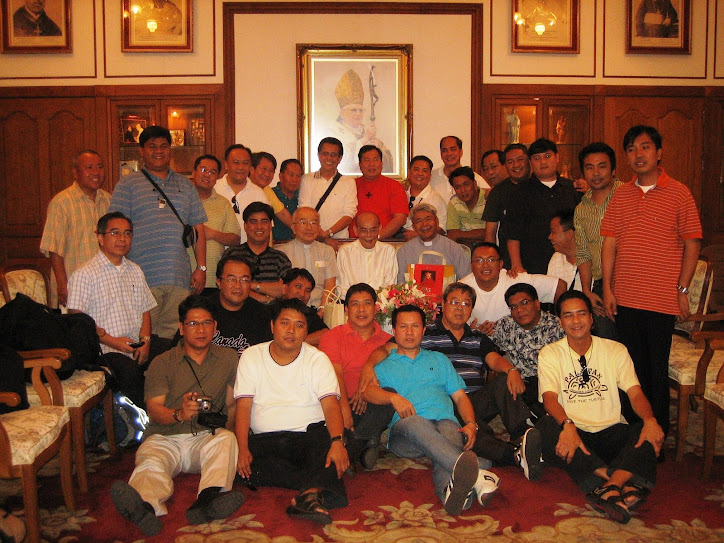
The clergy of Laoag with the lone cardinal of Thailand and the bishop of Changmai

Homily of Most Rev. Sergio Utleg, Bishop of Laoag, on the occasion of the Installation of Most Rev. Joseph Amangi Nacua as Bishop of Ilagan

Most Rev. Joseph Nacua, Bishop of Ilagan,
Most Rev. Archbishop Edward Joseph Adams, Apostolic Nuncio to the Philippines,
Most Rev. Archbishops and Bishops,
Rev. Fathers and Sisters,
Honorable Government Officials,
Ladies and Gentlemen:

Recordatus Misericordiae Suae, Ever Mindful of His Mercy. The motto in Bishop Nacua’s Coat of Arms reminds us that God has indeed shown his love and mercy for this Diocese. For the last 20 months, Ilagan had no bishop. But because of God’s mercy and providence, the Diocese remained alive, people have kept the faith, the clergy continued to serve the people of God. This is no reason, however, to say that a diocese is better off without a bishop. And the reason for this is, as the Directory for the Pastoral Ministry of Bishops, Apostolorum Successores, quoting Vatican II, puts it: the bishop is the visible source and foundation of the unity of the particular church.

Without a bishop there is no local church. In a diocese, there may be zealous priests busy with their work, the Gospel may continue to be preached eloquently, the diocesan programs may be efficiently implemented, but without a bishop the diocese will be unreconizable as a local church and will eventually disintegrate. That is why, we are doubly grateful to God for his infinite goodness and mercy, because he has finally provided the Diocese of Ilagan with its Pastor and Bishop.

To be a visible sign and guarantee of unity in the Church! What a terrifying idea! This is the reason for the exalted dignity, the over-arching power, the unprecedented prestige of the Bishop, all summed up in two words when he is addressed as: His Excellency! But I doubt if there is any man, who upon learning that he has been chosen by the Holy Father to be a bishop will not stand in fear and trembling at the thought of the heavy responsibility that he is about to bear on his frail shoulders.

The responsibility is tremendous because the Bishop is being asked to personify the Most Holy Trinity to his flock. The same document, Apostolorum Successores says: “through his life and episcopal ministry (the bishop) manifests to the people of God the Fatherhood of God… the loving care, mercy, gentleness and authority of Christ… and the vitality of the Holy Spirit who gives life to the Church and sustains her in her human weakness.” The bishop has to be a father, a brother, a shepherd, a manager, an inexhaustible source of hope, a guide, a rock of strength, a fountain of life. Who then can be worthy to be a bishop? Who can even aspire to be a good bishop? The answer is: nobody. Nobody because the bishop is expected to configure Christ, and nobody can ever be like Christ himself.

Yet, it is also true that our christian life is a mixture of what is human and what is divine, of body and spirit, of immanence and transcendence, of sinner and saint. The Church is a paradox, and no one has expressed this truth in a better way than Vatican II itself when it says about the church that it is: ecclesia sancta sed semper reformanda. The church is holy, but always in need of reform. It is as though the church and all of us who compose the church have been given two grades simultaneously: E and NI. E because we the church are excellent, holy, divine… but at the same time NI, needs improvement, because we are always making wrong choices, falling into arrogance, committing sin, breaking promises, and coming short of our goals.

When I was asked by Mons. Marino Gatan to be the homilist for this Mass, I was sure that I was chosen to do this difficult but privileged task not because of my profound insights on Ecclesiology and the nature of the Episcopacy but because, as the former bishop of this diocese, I would be in the best position to give advice to the new bishop.

And so my dear Bishop Nacua, I know that you have a Doctorate in Spirituality but since I am two years your senior in age, and eleven and a half years older than you in the episcopacy, allow me to give you some unsolicited advice. Bear in mind always that the life and mission of a bishop, as that of the Church herself, is a paradox.

 Paradox number one: power and servanthood. As a bishop you have almost absolute powers in the executive, legislative and judicial forum. Yet many times you will find yourself obeying and doing what others want and tell you to do. There is nothing strange about that. You are given power so that you will have greater capacity and freedom to serve.

 Paradox number two: readiness and preparation. There is no school that prepared you to be a bishop, yet you are expected to know what to do. After this installation, with the barest of instructions, you are thrown into the job in full gear. Yet there is so much for you to learn, and skills that you have to acquire and points of view that you have to be familiar with. But do not worry. By the grace of your ordination, the Holy Spirit will be there to help you. Apostolorum Successores says: As teacher of the faith, sanctifier and spiritual guide, the Bishop knows he can count on a special divine grace conferred upon him at his episcopal ordination.

 Paradox number three: grave responsibility and letting go. You are responsible for the growth of the church, the preaching of the Gospel, the harmony of all the different groups within the diocese. Yet sometimes you feel that things are happening, and many times doing well, without your knowledge or control. You get the feeling that things go on without you; they are, in fact, prospering not because of but in spite of you. This only tells you that what you are doing is really God’s work. You are there only as his instrument. You sow the seed but God makes the plant grow and bear fruit.

 Paradox number four: agony and ecstasy. Sometimes you will feel like you are in heaven because of the adulation of the flock and all your plans are flourishing and running smoothly; other times you feel you are at the fringes of hell because you are misunderstood, maligned and everything you say and do is wrong. The life of a bishop is sometimes colorful and exciting, but oftentimes it is grey and monotonous. Sometimes you want to shout to the whole world: God is good. Life is wonderful. At other times you are forced to say, as Jesus on the cross: My God, My God, why have you forsaken me. It is a life that is exhilarating and fulfilling, but at the same time it is demanding, exhausting and humiliating. But that is something that should not scare you or surprise you, because it is also the life of Jesus Christ, the Head and Shepherd of the Church, of whom you as Bishop is the struggling image.

 Paradox number five: losing and finding yourself. He who loses himself will find it, as Jesus says. People will want you to be this and to be that. Yes, you are supposed to lose yourself among your people, but paradoxically, the best way for you to do that, is just to be yourself. The world will want to carve you according to its image, but the most precious thing you can offer to the world is YOU.

I like your motto: ever mindful of his mercy. Had I known better, I might have adopted it for my own. As a bishop, like Christ, you will preach the good news to the poor, give sight to the blind, and set captives free; but your journey will be strewn with thorns, rocks, storms and sleepless nights. Be consoled that anything that happens to you will always be an act of God’s love for you. There will be times when you will find yourself floundering in a stormy sea with waves big enough to drown you. In the end, God’s mercy and compassion will be the only reality you can rely on and will ever need. May our good and merciful Lord be always with you.

Ilagan, September 9, 2008.

Ti Krus ket Bendision

"Ti agtarigagay a sumurot kaniak masapul nga ibaklayna ti krusna...”

Iti daytoy a gundaway malagipko ni Manny Pacquiao gapu ta sakbay ken tunggal rikos ti boksing, agtandaan. Adda met dagiti basketbolista ti PBA nga agtandaan sakbayda nga agay-ayam. Kasta met kadatayo, no lumabas ken umunegtayo iti simbaan, agtandaantayo met iti krus. Amin dagitoy ipakitada ti kinasiasinotayo - pasurotnatayo ti krus!

Agpayso unay, kakabsat, a ti Krus ti maysa kadagiti kapatgan a ramen ti biagtayo a Cristiano. Ti kinapudnona, maaw-awagantayo a relihion ti Krus agsipud ta ti tanda ti kina-Cristianotayo ket ti Krus.

Ti kinapudnona, idi nabuniagantayo kastoy ti kuna ti padi: “Felimon, iti nagan ti nacristianoan a gimong awatenka nga agpaay ken Cristo ket yugisko kenka ti tanda ti krus ni Cristo a nangisalakan kadatayo.” Naimaldit ngarud kadatayo ti tanda ti Krus manipud iti dayta a kanito. Manipud met laeng iti dayta a kanito, nagbalintayon a pasurot ti Krus. Isu't gapuna a no irugitayo a rambakan ti Nasantoan a Misa, agtandaantayo iti krus. Sakbay a mabasa ti evanjelio, agtandaantay manen, agsipud ta awan sabali a tanda wenno pagilasinan a Catolicotayo, no saan a ti Krus!

Ngem ti yanna a rigat, adu kadagiti Cristiano ti madi iti krus. Adu kadagiti Catolico ti agkedked a ma-addaan iti krus. Kayatda piman nga itarayan ti krus. Yes, we run away from danger because we must preserve ourselves, but we must not run away from the cross. The cross is not our danger, the cross is our salvation! We do not run away from the cross, we run away from sin. We do not run away from Jesus Christ, we run away from the evil one. Wen, itarayantayo ti peggad tapno mailisitayo iti didigra, ngem saan a rumbeng nga itarayantayo ti krus agsipud ta ti krus ti salakantayo! Ti basol ti rumbeng nga itarayantayo, saan ket a ti krus. Ni Satanas ti rumbeng nga itarayantayo, saan ket a ni Apo Jesus!

Laglagipentayo a no mangted man ti Apo iti pakarikutantayo, saan a gapu ta binaybay-annatayon, saan a gapu ta nalipatannatayon, saan a gapu ta tinallikudannatayon ken saan met a gapu ta naliwayannatayon, ngem gapu laeng iti ayatna nga iparaman kadatayo ti kapatgan a gamengna – ket daytoy awan sabali no di ti Krusna! We should, therefore, rejoice in the cross. Remember that in every blessing is a cross, and in every cross is a blessing!

Wen, kakabsat, tunggal mangbendision ti padi – adda latta ti krus. Awan ti bendision nga awan ti tanda ti krus. Isu a no malpas ti tunggal misa agtandaantayo iti krus, saanen a tapno iparangarantayo ti kinasiasinotayo ngem tapno mabendisionantayo. Gapuna a ti siasinoman a madi iti krus, awan met kalinteganna a mabendisionan!

Ibaklayyo ti krusyo, kakabsat. Wen, ibaklayyo ti krusyo ken dikay kad ibbatan lattan. Awitenyo ti krusyo ken dikay kad ibati lattan iti uray sadinoman. Awitenyo ti krusyo ken dikay kad satsaten lattan. Awitenyo ti krusyo ken dikay kad ipadpadawat lattan! (Fr. Walde Batoon)

St. Nicholas of Tolentino: A Biography

The Journey of a Great Confessor

At times God desires that the design for sanctity in a soul be etched early in life. Born in 1245, in Sant' Angelo, a town in the Italian Marches, a province east of the Central Appennines, Nicholas was the answer to the prayers of his middle-aged parents. He displayed a desire for prayer and solitude at an early age, and at seven began various practices of penance and mortification. He was tutored by a local priest and made rapid and gifted progress, which brought him to the attention of the bishop of Fermo.


While still a boy, Nicholas received minor orders. Refusing a career in the secular clergy, he desired a way of life in which he could consecrate himself completely to God. He chose the order of Hermits of Saint Augustine after hearing one of the friars preach, and made his profession before he was eighteen. He was sent to San Ginesio for his theological studies and while there was given the charge of distributing food to the poor at the gate of the monastery. So great was his generosity with the food of the house that the procurator complained and reported him to the prior. It was here, too, that Nicholas performed the first of his many miracles by placing his hand on the head of a sick child who had come to the gate. Nicholas said, "The good God will heal you," and the child was cured. Nicholas was ordained about 1270 and during his first Mass was rapt in ecstasy. From this time on, he had the gift of conversions through his sermons and his instructions in the confessional.

While visiting a relative who was the abbot of a monastery near Fermo, Nicholas was invited to give up the hard life he had chosen and stay at this more comfortable monastery, but while he was praying in the church, he seemed to hear a voice saying, "To Tolentino, to Tolentino. Persevere there."

And so Nicholas went to Tolentino. Tolentino at this time was still suffering from the Guelf and Ghibelline struggle, and the weakening of religious faith that resulted from war and heresy. A campaign of street preaching was necessary to revitalize Tolentino, and Nicholas was put to this work, making a great success of it. Even those who tried to drown out his voice and disband the crowds that gathered to listen to him finally stayed to hear him and to repent their own sins. Nicholas also worked in the slums of Tolentino, comforting and caring for the sick and appealing to sinners. Miracles always accompanied this work.

Less public than this apostolate to the sinners and to the suffering were the practices of penance and the long hours of prayer that were the source both of his success and of his sanctity. Always exceptionally faithful to the community office in the monastery church, he added many more hours of prayer both day and night, in the church and in his own cold cell. Only humble obedience to his superiors kept him from the strict fasts and harsh self-denial that threatened to make him an invalid.

Nicholas died in 1305, and the miracles that followed were so numerous that the case for his canonization was immediately drawn up. The grave difficulties of the Holy See that resulted from the transfer of the papacy to Avignon delayed any action on his cause until 1446, when he was canonized by Pope Eugenius IV.

Source: Welcome to the Catholic Church 3.0 by Harmony Media, Inc., PO Box 9179, Salem, OR 97305 USA.

CATECHETICAL AND MISSION OFFICE: Outreach in Adams, October 29, 2008

CATECHETICAL AND MISSION OFFICE: Diocesan Catechetical Day, September 20, 2008, Part 1 (2)

CATECHETICAL AND MISSION OFFICE: Diocesan Catechetical Day, September 20, 2008, Part 2 (2)

COM. ON THE CLERGY & OFF. ON CH. HERITAGE: Convocation (Playa Tropical, Currimao, Aug.18-20, 2008)