The Laoag Clergy

NEW BLOGSITE!

Visit St. Anthony of Padua Parish, Marcos, Ilocos Norte.

The CHRONOS: Monthly Diocesan Schedule for FEBRUARY 2009

July 26: Laoag's foundation anniversary and St. Anne Parish fiesta

Today, the Diocese of Laoag celebrates her 48th birthday. Today, too, is the launching of activities in commemoration of the diocese's golden anniversary in 2011.

Let us pray for our diocese. Let us pray for the increase of faith and the deepening of love and commitment to God and the Church.

Happy fiesta to the Piddiguenos!

Click here to read CBCP news on the launching.

July 25: Fiesta greetings!

Today is the feast of St. James the Greater.

Happy fiesta to our brothers and sisters in Solsona and Pasuquin!

Cadaratan Church: A Miracle in Progress

Cadaratan Church: A Miracle in Progress


The Dream Church of Our Lady of Fatima Parish, Cadaratan, Bacarra, Ilocos Norte

The Dream Church of Our Lady of Fatima Parish, Cadaratan, Bacarra, Ilocos Norte

Foundation for the church-construction project in Cadaratan, Bacarra put up!

The construction of the OUR LADY OF FATIMA PARISH CHURCH started anew, September 8, the birthday of Mama Mary. Very crucial in this project is the financial consideration being tacked by the whole parish community. To address this concern, we, the Parish Pastoral and Finance Councils, together with our newly-appointed parish priest, Rev. Leonardo L. Ruiz, planned to put up a FOUNDATION for the continuation and completion of the construction of the parish church.

The Foundation is chaired by our beloved Bishop, Most Rev. Sergio L. Utleg, D.D. and the members of the Board include Victor R. Bolosan, M.D., Rosalina R. Javier, Flordelina T. Cadelina, Eugenia M. Mendoza, Emilia B. Agonoy and Dante Subia, all from Our Lady of Fatima Parish.

Registration of the Foundation with the Securities and Exchange Commission (SEC) is under way.

Architects and Engineer: Arch. Coleen Cajigal and Arch. Joemar Bolosan, Engr. Eduardo Cid.

FINANCIAL ASSISTANCE IS NEEDED. For those who wish to send their donations directly through the bank, this is our bank: PHILIPPINE NATIONAL BANK, Batac Branch, Batac, Ilocos Norte, Philippines. DOLLAR ACCOUNT NUMBER: 158881300038; Account Name, Most Rev. Sergio L. Utleg, D.D., Victor R. Bolosan, M.D. and Flordelina T. Cadelina. PESO CHECKING ACCOUNT: 158881300020, with the same above-mentioned account name.

The Happy Priests

The Happy Priests
The clergy during their annual retreat with Bp. Mylo Vergara of the Diocese of San Jose, Nueva Ecija as retreat master at Betania Retreat House in Baguio City, November 10-13

HELP BUILD THE CHURCHES OF OUR YOUNG PARISHES!

ST. JOHN BOSCO (BARESBES, DINGRAS)
ST. JOSEPH THE WORKER (CARASI)
ST. FRANCIS OF ASSISI (DAVILA, PASUQUIN)
OUR LADY OF FATIMA (CADARATAN, BACARRA)
ST. ROSE (STA. ROSA, SARRAT)

OUR MOTHER OF PERPETUAL HELP (PANCIAN, PAGUDPUD)

For financial assistance or donations in-kind, please contact the Bishop or the Curia at (077)770-5210, or Fr. Lorenzo Torreflores (Baresbes, Dingras) at 0917-5701085, Fr. Danny Devaras (Carasi) at 0920-5537806, Fr. Lester Menor (Davila, Pasuquin) at 0915-7879701, Fr. Leo Ruiz (Cadaratan, Bacarra) at (077)670-3801, and Fr. Anthony Dimagiba (Sta. Rosa, Sarrat) at (077)782-2031, Fr. Antonio Calautit, SVD (Pancian, Pagudpud) at 0918-5228902.


Listen to DZEA-CMN Radio Totoo, 909 khz!

Pray for your priests. They need your prayers as much as you need theirs.

Pray for your priests. They need your prayers as much as you need theirs.
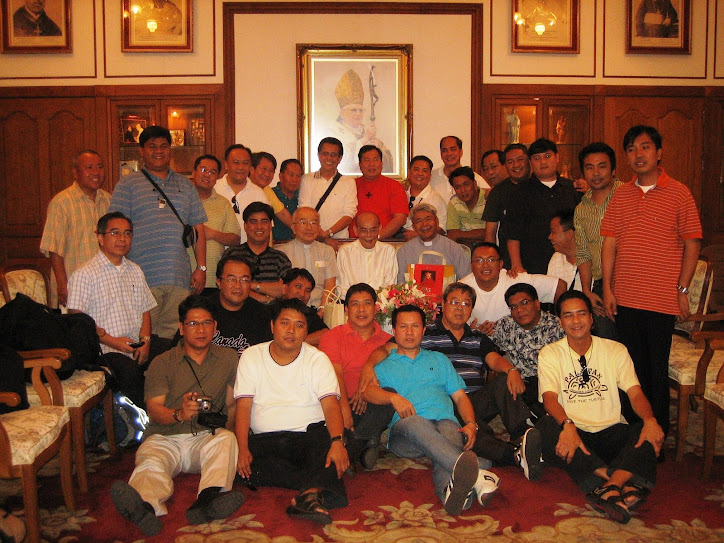
The clergy of Laoag with the lone cardinal of Thailand and the bishop of Changmai
Showing posts with label History. Show all posts

THE DIOCESE OF LAOAG: The Faith Grows From the Ashes of the Aglipayan Schism, by Rev. Danilo R. Laeda

The turn of the 20th century saw the Church in the Philippines being put asunder. The once monolithic faith established by the zealous and indefatigable Castilian missionaries three centuries and a half before was shaken due to the Religious Revolution as an offshoot of the nation’s quest for sovereignty to shake away the yoke of colonialism in the last decade of the 19th century. This was a fight in the religious sphere of the Filipino clergy towards self-determination, that is, an all-Filipino hierarchy. Of the five ecclesiastical jurisdictions then existing in the country, the then Diocese of Nueva Segovia suffered the most. The epicenter of the tremors was in Ilocos Norte. This was understandable since the man whose name was stamped in the schism, Gregorio Aglipay y Labayan, was a native of the province. Practically the whole province, with the exception of few families, was swept by the tide of national feelings. Only one priest of the seventeen then assigned in the province remained in the fold.

A hundred years later and with an ecclesiastical jurisdiction comprising the whole province of Ilocos Norte, the Roman Catholic faith has grown considerably. The once moribund Church loyal to the Roman Pontiff is now more vigorous than ever.

Colonization of Ilocos Norte and Christianization

Long before the coming of the Spaniards, there already existed an extensive region (consisting of the present provinces of Ilocos Norte, Ilocos Sur, Abra and La Union) renowned for its gold mines. Merchants from Japan and China would often visit the area to barter beads, ceramics and silk with gold. The inhabitants of the region believed to be of Malay origin, called their place Samtoy from saomi ditoy, which literally meant “language spoken in this place”.

Like other parts of the Philippines, Ilocos Norte before the advent of Spanish colonization was inhabited by different tribes. Settlements were located along the river systems. Most people preferred to settle down near their farming or hunting grounds. Trade between seashore communities and nearby China must have been present considering the proximity of the place with mainland Cathay. Religion was mainly animistic with the belief in Supreme Being like “Kabunian” and other minor spirits which were collectively known as di-kataotao-an.

The Diocese of Laoag shares the early history of its mother see, the Archdiocese of Nueva Segovia. Christianity came to this part of the country in June 1572 during Northern Luzon “pacification” campaign led by the Spanish conquistador Juan de Salcedo and his Augustinian chaplain Alonzo de Alvarado. It is said that the cross was first planted on top of what is now known as Ermita Hill in Laoag. However, it was not until 1575 when Vigan was finally “pacified” by the Castillians that effective evangelization campaign reached this part of the newly established Province of Ilocos. During this last quarter of the 16th century, mission centers were established in Laoag, Bacarra, San Nicolas, Batac and Dingras. Towards the end of Spanish rule in the Philippines, there were 13 towns. The evangelization of this northern part of Ilocos Province was done by the Augustinian friars. They did their apostolate here until the end of Spanish rule in 1898.

Ilocos norte was so remote from the central government in Mnaila during the Spanish Regime. It was rural and rustic. Owing to the abusive practices of many Augustinian friars, a number of Ilocanos revolted against their colonizers. A number of uprisings erupted. Noteworthy of these were the Dingras uprising (1589) and Pedro Almazan revolt (San Nicolas, 1660). One in Bacarra led by a certain Juan Magsanop was triggered by a series of revolts in the south in the 17th century. The Augustinian parish priest of the town Juan de Arias was killed by the rebels. In the first quarter of the 19th century three rebellions in a row erupted in a period of fifteen years, which prompted the colonial government to divide the Ilocos province in 1818. One of these revolts in Piddig town was caused by the government’s attempt to put a monopoly on the production of basi, a locally produced wine fermented from sugarcane juice.

The Rise and Decline of Aglipayanism

Three quarters of a century later this rebellion was experienced in the religious sphere. The Philippine Religious Revolution at the turn of the 20th century that gave rise to the Philippine Independent Church (Iglesia Filipina Independiente [IFI]) made Ilocos Norte as the epicenter. Only one of the seventeen Filipino priests then assigned to the province remained steadfast to the Catholic faith. This was mainly because the former guerilla padre Gregorio Aglipay, now the religious leader of the new schismatic movement was from Batac and both his lieutenants, Simeon Mandac and Santiago Fonacier were from Laoag. The “Independientes”, (to distinguish them from the “Romanos”) as they were subsequently called, brought with them about 95% of the total population of Ilocos Norte.

It was a slow and painful recovery for the “Romanos” in this part of the Philippines. The years following 1902, the foundation year of the IFI, were difficult. All church properties except the Laoag Cathedral were taken over by the schismatics. However, the Philippine Supreme Court’s landmark decision in 1905 (Barlin vs. Ramirez) ordering the return of properties belonging to the Roman Catholic Church, which were taken over by the Independientes, saved the day for the Romanos. By 1908 appointees for the parishes in Ilocos Norte took their billet. Practically all of them were soon withdrawn because they suffered indignities from the “Aglipayanos”. A strategy was worked out by the then American Bishop of Nueva Segovia, the Most Rev. Dennis Dougherty. Priests were soon assigned to their hometown to bring back to the fold their relatives and their tenants. Hence, we have the likes of Luis Cortez of Badoc, Mariano Pacis of Vintar, Clemente Edralin of Sarrat, who was later murdered in his convento of mysterious causes, Atanacio Albano of Bacarra and others.

The Canonical Erection of the Diocese of Laoag: Antonio Ll. Mabutas as Bishop

The Civil Province of Ilocos Norte became the Diocese of Laoag in 1961. The first bishop was the former chancellor of the mother see of Nueva Segovia, Antonio Lloren Mabutas of Agoo, La Union. The next decade saw the building up of the new diocese. Infrastructure had to be built and the people spiritually prepared and clergy had to be united.

The St. Mary’s Seminary opened its doors to the first batch of seminarians in 1963, although the construction was still going on. The bishop’s residence soon stood up along Gomez Street in the then outskirts of Laoag City. The Catholic Center Building near the cathedral replaced the old Knights of Columbus building, Catholic Schools were opened (St. Anne in Piddig, St. James in Pasuquin, St. Lawrence in Bangui and St. Jude in Pagudpud) to add to those already existing at the time of the separation. Two parishes were erected: St. Anthony of Padua in Marcos and St. Gabriel in Nueva Era.

Lay formation was centered on the Cursillos de Christianidad. This was a weekend lived-in retreat. Then came a new trend in catechesis, the Christian Community Program. This was a different approach from the Baltimore-type of traditional catechism. The Diocese of Laoag was one of the experimental centers for the whole Philippines.

A good number of priests from La Union (6) and Ilocos Sur (6) were “trapped” in the Diocese of Laoag as a result of the separation. Unity and spiritualization among the clergy had to be worked out. The monthly recollection and meeting had to be consistently held. Priests from every nook and cranny of the diocese were urged to go to Laoag every month for this event. These were the times when coming to the center was still a feat considering the dust and bumpy roads to the interior parishes in the eastern and northern vicariates.

Bishop Rafael Montiano Lim: A Tagalog in the Heart of Ilocandia

When the 1970s came, storm clouds were looming in the horizon for the Diocese of Laoag. In 1970, Bishop Mabutas was elected coadjutor Archbishop of Davao. Archbishop Juan Sison of Nueva Segovia was apostolic administrator during the months of vacancy. The following year Bishop Rafael M. Lim of Boac, Marinduque (then a part of the Diocese of Lucena) came to Laoag. This was a difficult decade everywhere: the first and second quarters saw the storm of activism, the “hippie” generation, martial law and dictatorship, the changes brought about by Vatican II were now being felt.

It was Bishop Lim who introduced the first reshuffle of priests’ assignments in the diocese, thus moving the well-entrenched “immovables”. The general reshuffle in 1973 also tried to standardize the finances of the parishes with priests theoretically receiving equal remunerations. A system of parish financial reporting was established with transparency as the end in view. this did not progress in the ensuing years, and it was eventually dropped to give away to the quota system, that is, each parish was assessed and the amount to be submitted to the curia was fixed.

The Diocese experienced the exodus of priests in this decade. Many priests either left the diocese or left the active ministry. By 1978 five parishes were already without priests. In the middle of this year, Bishop Lim became the first bishop of the newly created Diocese of Boac, Marinduque, his home province. The Rev. Jose F. Agustin served as diocesan administrator.

Edmundo Madarang Abaya: The shepherd for 20 years

By early 1979, the diocese had its third bishop in the person of Edmundo M. Abaya of Candon, Ilocos Sur. The next two decades saw the diocese on the rise. New orders of Sisters came mainly to do pastoral work. At its highest number, there were 17 religious orders of sisters working in the diocese. The priestly identity crisis brought about by the shift of things by Vatican II was on the wane. More vocations, hence more ordinations, were coming up. The catechetical program of the diocese was beefed up with a more centralized management. However, the once thriving Catholic Schools in the diocese were on the run because of many factors.

The strong earthquake of 1983 wrought havoc and destruction to the centuries-old churches of the diocese. Two years later all the destroyed churches and rectories were rebuilt or restored.

The diocese of Laoag celebrated the 25th anniversary of its foundation in 1986 with much fanfare. Archbishop Antonio Mabutas of Davao, the first ordinary, presided over the opening Eucharist. The San Lorenzo Medical and Dental Charity clinic was also inaugurated to serve the indigents who need medical and dental treatment. About the same year, the Foyer de Charite in the compound of the St. Mary’s Seminary was slowly rising to serve as a retreat house for the diocese.

In 1994, Bishop Abaya convoked the First Diocese of Laoag Pastoral Assembly. This was in response to the renewal of the Philippines called for by the Second Plenary Council of the Philippines in 1991. This was a week-long gathering of clergy, religious and lay faithful of the diocese to pray, to reflect on the pastoral situation and to offer solutions and remedies. It was geared towards creating a community of disciples in the Diocese of Laoag. The Vision-Mission Statement with the Acts and Decrees of the Pastoral Assembly reflects the pastoral situation of the diocese and the kind of response to be addressed to such.

Bishop Abaya’s episcopal ministry in the Diocese of Laoag came to an end when he was installed as the Archbishop of Nueva Segovia on September 8, 1999. The diocese was again without a pastor. The months of interregnum were under the leadership of the Rev. Rodolfo R. Nicolas, who served as administrator for 16 months.

Fourth Bishop: Another Ilocano From the Southern Ilocos Province

On January 30, 2001 Bishop Ernesto A. Salgado became the fourth Bishop of Laoag. A native of Sta. Lucia, Ilocos Sur, he was originally a priest of Nueva Segovia. When he took possession of the See of Laoag he was already a veteran in the mountain missions of the Cordilleras having served as Apostolic Vicar of the Mountain Provinces for 14 years.

Bishop Salgado steered the 40th anniversary celebration of the Diocese of Laoag with the Church as Mystery of Communion as its theme. The celebration was held on July 28, 2001, a Saturday, to allow more faithful in the celebration. The biblical exegete Fr. Gerardo Tapiador was the main speaker.

There are three things the bishop Salgado wanted to do in his episcopal ministry in the diocese of Laoag. First is the security of priests to make them veritable servant-leaders of this particular church. Priestly solidarity and fraternity was the second, to create a community of servant-leaders reminiscent of the primitive Christian community in Jerusalem. And the third was the formation of Basic Ecclesial Communities (BEC) to create a community of disciples.

Indeed, this was a gargantuan task. But the life of the priests and the faithful is what makes the Church. Talis sacerdos, quails grex, so the old Latin Maxim goes. A dedicated and unified presbyterium would be the first witnessing of the priests towards BEC. Basic Ecclesial Communities could only endure for as long as they are served by dedicated and selfless priests.

Four new parishes were erected during Bp. Salgado’s term: St. Francis of Assisi in Davila, which was carved out of St. James in Pasuquin; Our Lady of Fatima in Cadaratan from St. Andrew in Bacarra; Divine Mercy in Pila, comprising the 10 barrios in the northwestern portion of Laoag; and, St. John Bosco in Baresbes, covering three barrios at the eastern side of Dingras. St. Joseph the Worker in Carasi was being prepared but events did not permit its formal erection as parish during the tenure of Bp. Salgado.

After much rev up, Bishop Salgado was still taking off when he was named to his mother see, the Archdiocese of Nueva Segovia, which he took possession on May 31, 2005. The former Vicar General, the Rev. Jacinto A. Jose, was elected by the Board of Consultors as the diocesan administrator. He could not wait for the coming of the new Bishop of Laoag, though. He was ordained Bishop of Urdaneta on November 26, 2005. The Rev. Policarpo M. Albano continued to steer the diocese in the months of vacancy.

Bishop Sergio L. Utleg: Coming Back to His Roots

The diocese was sede vacante for 16 months. On November 13, 2006, the then ordinary of Ilagan (Isabela) Bishop Sergio Lasam Utleg was named to the See of Laoag. Bishop Utleg was formerly a priest of the Archdiocese of Tuguegarao, being a native of Solana, Cagayan. He was appointed coadjutor Bishop of Ilagan in 1996 and eventually took possession of the see a couple of years later. The appointment of Bishop Utleg to the See of Laoag is a homecoming of sort. His paternal grandfather was a native of Laoag who migrated to Cagayan. He was installed the fifth Bishop of Laoag on January 11, 2007.

To prepare for the forthcoming reshuffle of priest’s assignment and to have a firsthand knowledge of the whole diocese, Bp. Utleg immediately embarked on a pastoral visit. This commenced in February and completed in September of 2007. The bishop’s advocacy for environmental protection was immediately made manifest. He is practically making waves with the mountain climbing that he organizes to conquer the highest peaks of Ilocos Norte: Mt. Siminublan in Nueva Era, Mt. Masadsadoc in Vintar, Pico de Loro in the boundary of Pagudpud and Adams. Cycling buffs flock to him in his trek of the highways and the byways of the province.

The general reshuffle of priests’ assignments went through in April 2008, thus continuing a tradition of periodic transfer since 1973. Diocesan commissions were reorganized and the parish councils are being given a new direction with a uniform constitution and by-laws to be adopted in the whole diocese. Streamlining of the financial management of the parishes is now being prepared to adopt a uniform system thus paving the way towards a standardized remuneration of the clergy.

The 50th anniversary of the foundation of the Diocese of Laoag is two and a half years away. This early Bp. Utleg has already started to lay down the groundwork for the celebration. He has tasked the presbyterium to craft a five-year diocesan pastoral plan. The 1994 First Diocese of Laoag Pastoral Assembly will soon be revisited for a reorientation to the present pastoral needs of this particular church.

The Roman Catholic faith has come a long way in this part of the Philippine archipelago. Thrown in the abyss of a schism a century ago there was only a flicker of light at the end of a long tunnel as the virus of apostasy spread in an epidemic proportion like the Bubonic plague. The recovery was slow but steady. The erection of the Diocese of Laoag in 1961 weaned from the mother see of Nueva Segovia exacerbated the growth of the faith. Although few shock waves are still felt at times relationship with our Aglipayan brethren has become more friendly if not cordial. Things are now seen in the lens of ecumenism espoused by Vatican II.

Sta. Rosa, Sarrat Parish History

ST. ROSE OF LIMA PARISH
Founded: 1999
Patronal Fiesta: August 23


Sta Rosa is a district of the municipality of Sarrat, comprising Barangays San Lorenzo, San Nicolas and Sta. Rosa, a barangay named like the district. The present church of this parish is situated at Barangay San Nicolas along the road going to eastern Ilocos Norte. The name of the barangay confused mailmen to the name of the municipality adjacent to its immediate west. Aside from assuring that their letters would reach their residences, the people opted to change its name into San Miguel, to perpetuate their affinity to the mother parish, which was first named after the archangel.

St. Rose of Lima Parish of Sarrat, Ilocos Norte is the youngest parish in the Diocese of Laoag. It comprises the 13 barangays south of the Padsan River. For centuries, the area was under the mother parish of Sta. Monica established in 1724 by the Augustinian missionaries. Its history therefore is concomitant to its mother parish. The great river Padsan divides the town of Sarrat; the town proper being located in the northern part. The Augustinians would simply go to the southern portion of the town through bangka. In the dry season, barangay folks as far as Pandan used to go for Church services through their karison. With the advent of modern means of transportation, going for mission to the south became a burden for pastors passing through Laoag and San Nicolas.

The earlier priests who have served in Sta. Monica have done their part in the evangelization of the people in the baliw (the other side) or abagatan ti karayan (south of the river). The late Rev. Rosario Lopez built the first chapel made of galvanized iron. This chapel was located in Sitio Tibunay. Later after seeing the growth of the population and their need for a bigger place to worship, Fr. Lopez built a bigger chapel in a piece of land given to the church in Brgy. San Nicolas. The late Rev. Gil Albano, Jr. made improvements of the sanctuary of the second chapel.

In 1993, Rev. Jacinto Jose became the pastor of Sarrat. He initiated programs such as the work of the lay missionaries in forming BEC’s (NASA). The Christian Education Program in the schools, and through the help of the seminary fathers, the community of this district had Holy Week celebrations. Chapels of concrete and good materials were also built for the communities in Patad, San Antonio, Pariir and Parang. Eventually, due to the growing faith of the people and their generosity, the old chapel in Sta. Rosa was replaced with a more spacious and sturdier building. On December 28, 1997, Bishop Edmundo Abaya blessed and inaugurated the new house of prayer. Meanwhile, in Sta. Monica, Rev. Leobardo Lorenzo was assigned parochial vicar.

On September 5, 1999, the new parish of Sta Rosa de lima was created. This new parish includes all the barangays south of the Padsan River. Rev. Leobardo Lorenzo was appointed first pastor of the new parish. Fr. Bardz turned the choir loft into a residence (convento), procured the things needed for the parish office and for liturgical celebrations. He organized the parish pastoral council and the parish finance council and the barangay pastoral coordinators.

Rev. Pitz Acoba, who replaced Rev. Bardz as pastor, intensified the work of BEC formation in the parish.

Rev. Anthony Dimagiba is the present pastor.

Banna Parish History

ST. ROCHE PARISH
Founded: 1936
Patronal Fiesta: August 16


Motorists going to this parish for the first time must be careful in reading the road signs and markers, they may not find the name of the place they have in mind. The town and parish is more popularly known as Banna but was changed to “Espiritu”, after a former governor of Ilocos Norte and native of the place, through a congressional act. The sentiments of the people are common in retaining its old name even without a repeal to the former legislation.

As a town, it was part of Batac, which is adjacent to its west boundary. As a parish, it was formerly a visita of Dingras, and a Catholic chapel was erected in this town in 1935 through the initiative of Rev. Fortuna, pastor of Dingras. It was canonically erected in April 1936 with the Rev. Pomposo Pimentel as its first pastor.

During the term of Rev. Policarpo Albano, the old church was replaced with a new one, modern in style and more spacious. This is to accommodate the ever-growing faithful of the town. The priests assigned after him continued the construction of the new church, which is exquisitely unique creating a different feeling of awe for worshipers accustomed to the structure of traditional churches.

At the height of the Aglipayan Schism in 1902, about 97 percent of Ilocos Norte were enticed to join the religious sect. The return of the faithful to the Catholic fold began its gradual phases with the landmark Supreme Court decision of 1905 returning properties of the Catholic Church taken over by the Aglipayans. Since that time, Banna still remains a predominantly Aglipayan town. This challenge was the constant struggle of priests assigned in the parish under the tutelage of the miraculous San Roque. The presence of the Pastorelle Sisters (Sisters of Jesus Good Shepherd, Pastorelle) collaborating in the pastoral work, gave new hope for Catholicism in the town. For the first time, school children in remote areas saw women in religious habits. The parish is the ideal site of a mission area conceived by their Father Founder. Despite meager means, the sacrificing sisters throughout the years are determined to realize their mission. The parish will remain a part of the continuous unfolding of the history of this Italian-born religious congregation.

Since the foundation of Laoag as a diocese, the following have served as pastors: Rev.Damaso Argel (1957-1963); Rev.Andres Respicio(1963-1969); Rev. Saturnino Rafada (1969-1971) Rev. Antonio Molina (1971-1973); Rev. Jose Agustin (1973-1977); Rev. Mario Garaza (1977-1980); Rev. Policarpio Albano (1980-1985); Rev. Emil Valenciano (1985-1986); Rev. Victor Hernando ( 1986-1993); Rev. Manuel Lamprea, Jr. (1993-2001); Rev. Augusto Acob (2001-2004); Rev. Joel Bruno Barut (2004-2008); Rev. Frederick Astudillo (2008 to present).

Bangui Parish History

ST. LAWRENCE THE DEACON PARISH
Founded: 1624
Patronal Fiesta: August 10


The town of Bangui was an encomienda of Captain Riberos (1605) who requested for a minister from the flourishing town of Bacarra to come and work among the people. Thus the encomienda was converted into a visita of Bacarra, and a priest was sent there “for the consolation of the natives.” Since Bangui was nearer to Cagayan, it was annexed to the mission of Cagayan. On October 31, 1624, a council of the Augustinians separated Bangui from its previous matrix, and Fr. Francisco de Valenzuela was named prior-vicar of the parish. This new parish was placed under the patronage of St. Lawrence the Deacon, Martyr.

The years that followed saw different events in the parish. In 1635, Bangui was reduced again into a visita due to the lack of priests. Then after few years, it was considered again
a parish according to the number of souls. During the Malong-Magsanop uprising (1660-1661), a religious priest by the name of Fr. Jose Arias was assassinated in Bangui. Several priests were imprisoned in the years that followed.

After those turbulent years, Fr. Benito de Mesa made Bangui the “spiritual center” of his missionary expansion to the Apayaos. He was considered the founder of Bangui.

In 1668, Bangui was separated from Bacarra, together with Bangbangon, Vera and Adams. Fr. Domingo Soler was named vicar to all these towns.

During these years, the church in Bangui was made of stone and wood, materials which were easily worn out in the course of time. In 1877, Fr. Antonio Garcia rebuilt the church and made used of stones. The earthquakes of 1880 and 1891 damaged the old church and the convento which Fr. David Diez repaired. Again during the Japanese occupation, the church was heavily damaged. Recently, it has been retored and half of its original edifice is now utilized. Its nearby indigenous town of Dumalneg is also within the jurisdiction of this parish.

Three priests native of the town have been ordained: Rev.Peter Acoba (1982), Rev. Ronald Bonayon(1999) and Rev. Abraham Aguino, CICM (1999).

Since the foundation of the Diocese of Laoag, the following have served in the parish: Gaudencio Dacuycuy, Rev. Pedro Santos, Rev. Rosario Lopez, Rev. Dionisio Rios, Rev. Saturnino Rafada, Rev. Amador Foz, Rev. Teodoro Remigio, Rev. Noel Vander Plaetsen, CICM, Rev. Gaudencio Dacuycuy, Rev. German Cabillo, SVD, Rev. Artemio Rillera, SVD, Rev. Stanislao Ros, Rev. Tranquilino de Ocampo, Jr. SVD, Rev. Vicente Tiam, SVD, Rev. Pedro Acoba, Rev. Carlito Ranjo, Jr., Rev. Manuel Lamprea, Jr., Rev. Leobardo Lorenzo.

San Nicolas Parish History

Patron: ST. NICHOLAS OF TOLENTINE
Founded in 1584


The beautiful church of San Nicolas de Tolentino Parish speaks of the numerous people who kept the Catholic faith alive despite the turmoil of the past 400 years brought about by calamities that destroyed the church building and by the Aglipayan schism, which threatened the Christian community.

The community began as a visita of Vigan in 1575. Every year, an Augustinian missionary visited this community of Malay origin that settled south of the Padsan River. Under the patronage of St. Lawrence the Deacon, the first chapel of bamboo and cogon was built for the visita. This was replaced with a small church of masonry, wood and cogon. But this was soon destroyed by earthquake and typhoons.

In 1701, Fray Antonio de Villanueva constructed a bigger and more massive church about half the size of the present one. This construction was completed in 1703 only to be toppled down by a strong earthquake on November 14, 1707.

In 1733, a strong typhoon ravaged Ilocos Norte, and many of the townspeople took refuge in the church. They asked for the help of St. Lawrence, but the typhoon did not stop. Later, they turned to St. Nicholas of Tolentino, and the typhoon and ensuing flood miraculously subsided. This was the time that the town and the parish took the name of St. Nicholas of Tolentino.

In 1895, the church belfry was constructed under the leadership of Fray Victoriano Garcia, himself an architect and an engineer. Molasses was mixed with lime as a strengthening chemical for the stones and bricks.

During the revolution of 1898, the Katipuneros occupied the church. A year later, the American forces took over the church and used it as headquarters. However, the U.S. government ordered that churches be vacated by military forces. Gregorio Aglipay, together with renegade priests, took this opportunity to take over the church. Majority of the Catholics in the town embraced the Aglipayan Church. However, the Supreme Court decreed that the sequestered properties of the Catholic Church be returned by the Aglipayan rebels. The building was returned, but its records and movable properties could not be retrieved anymore.

During World War II, the church was occupied by Japanese forces, and its belfry became a watching post. After the war, Rev. Catalino Racca started the repairs of the church.

Before the turn of the millennium, the church façade and belfry went through a major facelift. New bells were added to the old set. Today, the parish boasts of having the only automated belfry in Ilocandia.

In 2004, the church underwent yet another makeover. But more than the physical transformation which is immediately palpable is the fervor of the faithful to wield greater zeal and strength of spirit to renew and be renewed and courageously walk the stretch ahead. Moreover, the faithful, motivated by their pastors, are invigorated with the spirit of charity and unity that fires up their hearts and spurs them on to do what they can for the good of the Church. Now, all they have to do is stay on course.

Since the creation of Laoag as a diocese, the following priests have served in the parish: Rev. Catalino Racca, Rev. Mauro Resurrecion, Rev. Juan Ballesteros, Rev. Policarpo Albano, Rev. Sylvio Lacar, Rev. Gil Albano, Jr., Rev. Rodolfo Nicolas, Rev. Amador Foz, Rev. Domingo Albano, Rev. Jose Agustin, Rev. Ruben Abaya (with Rev. Rey Magus Respicio then Rev. Engelbert Elarmo as assistants), Rev. Mario Garaza (with Rev. Joel Reynold Castillo then Rev. Nolasco "Tom" Pascua, Jr. then Rev. Lorenzo Torreflores as assistants), Rev. Ramon Danilo Laeda (with Rev. Melchor Palomares as assistant).

Vintar Parish History

Patron: ST. NICHOLAS OF TOLENTINE
Founded in 1774


Vintar was a visita of Bacarra in 1600 under the administration of Fr. Lazaro Ordonez, and it was established as a parish in 1774 under the patronage of San Nicolas de Tolentino. The Church of Vintar is a construction of the late 18th century. Fr. Mariano Ortiz restored it in 1894, and Fr. Ricardo Alonso restored the convent in 1877. According to Llanes, the convent, one of the biggest in the province, had an inner patio. A part of the mission complex was patterned after those found in Mexico; it was more of a decorative garden.

During the earthquake of 1931 the church was partly destroyed, and its subsequent restoration in 1935 lost its antique nobility and dignity. The bell tower collapsed and was damaged almost beyond recognition or repair. During the earthquake of August 17, 1983, the façade and the wall of the sanctuary collapsed.

The townspeople of Vintar practice great devotion to San Nicolas. A religious tradition left by the Augustinians continues to be practiced in Vintar. The town has the largest land area in the province. Aside from its vastness, the geographical barriers brought about by rivers and mountains make it hard for evangelization to progress. However, the priests assigned in their parish find joy in going to as far as Isic-Isic. Their pastoral mission has been complemented by the apostolate of the Daughters of the Divine Zeal, who have been in the parish since 1968.

In 1989, a Parish Pastoral Assembly was held in Vintar. On December 11, 1991, Rev. Primo Cabanos was ordained priest. That same year the diocesan Christ the King celebration was held in the parish. Rev. James Bonoan celebrated also in Vintar his silver anniversary of ordination on December 20, 1994.

Since the foundation of Laoag as a diocese the following have served as pastors: Rev. Mariano Saraos (1957-June 1967); Rev. Bernardo Balderas (July 1967-December 1967); Rev. Jose Agustin (1967-1969); Rev. Andres Respicio (1969-1972); Rev. Onofre Aurelio (1972-1976); Rev. Antonio Molina (1976-1980); Rev. Godofredo Albano (October 1980–December 1980); Rev. Domingo Albano (1981-1983); Rev. Damaso Argel (1983-1986); Rev. Tito Bonoan (1986-1993); Rev. Victor Hernando (1993-1994); Rev. James Bonoan (1994-2001); Rev. Ramon Danilo R. Laeda (2001-2008); Rev. Hermogenes G. Saturnino, Jr. (present).

Pasuquin and its pastors: circa 1800 by Fr. Ericson M. Josue

Introduction

Christianity is the golden diadem of all the legacies of the Spanish Augustinian Friars in the Philippines. Concomitant with it is the organization of towns and introduction of modest living to the locals. As part of the passing on of Faith, the frailes taught the natives the way to live corresponding to their identity as human individuals. Though limited by human frailty, the heritage that these Augustinians had left to Filipino culture and psyche is priceless.

Historians undeniably mentioned that most of the incalculable patrimonies of the Augustinians are found in the north --- in the Ilocos Region in particular. A glimpse of this heritage can be seen in the humble town of Pasuquin.

When Ilocos Norte was established by Royal Decree on February 2, 1818, Pasuquin was enlisted as one of the original towns of the province. It was formerly a visita (peripheral mission) of the Ministry of Bacarra (1590). The town is located about 18 kilometers north of the Cabessera of Laoag. It has a total land area of 18,940 hectares and a terrain of mountains, hills with plain and sandy lands. Rivers and creeks also abound in the place. Pasuquin was established as a parish in 1784 and was placed under the advocacy of Santiago el Mayor (St. James the Greater). Right after its foundation, Pasuquin took Bangui as a visita and remained as such after sometime. Pasuquin became a part of the herd being taken care of by the bishop of the old Nueva Segovia Diocese. A solid church used to stand with a measure of more than 90 meters long and 30 meters wide; almost plainly made of sand stones and bricks bound by the mixture of lime, molasses, egg yolks and juice extracted from sablot leaves. The 1891 Report of Don Camilo Millan would say that the spacious church had a roof of tiles. An old chronicle says that the church was far from being tagged as a handiwork of art but it possessed a certain unique architectural beauty. The source would further describe that the old church would remind a beholder of the Grecian Architecture. Before the earthquake of 1931 shook off its pediment, one could vividly see embossed columns of varying width and height. The chronicle said, “The massive stones…were shaped very much like the dome of a great cathedral.” Other edifices were also erected like the casa paroquial, casa municipal and escuelas. The cemetery, bridges and the grid-like streets were also among their works. All of these are the invaluable debt of the natives to the forbearers of faith.

To have a closer view of their contributions – sacramental and structural - this humble work presents short biographies and works of the Parish Priests of Pasuquin around the 19th Century which includes those who come from the clerigo secular (these were natives), who had also served the parish community as interinos (interim parish priest) and some as cura parrocos (parish priests). These were the men who sacrificed in “planting and watering” the seed of Faith in the place. The article shows a magnified look on the accounts that led to the building and edification of Pasuquin’s civilization and faith through the line of its pastors. The main sources were the canonical books of the parish, which enlists the curates of Pasuquin and archival materials from the San Agustin Museum in Manila, Museo Naval in Madrid and the Provincia Agustiniana del Santisimo Nombre de Jesus in Valladolid, Spain. The presentation starts from 1797 – the year when the earliest extant document in the parish was written.


1. R. P. Fray Santiago Bendito, OSA (1797-1801)

Fray Santiago Bendito of the Order of St. Augustine (OSA) is the first to sign the canonical books extant in the parish archives. He was born in 1761 in Valladolid, Spain and pronounced his vows to the Augustinian Order in the same city in 1778. He was sent to the Philippines and served in the Ilocos, particularly in the Parishes of Bangui in 1787, Sarrat and Vintar in 1789 and Bacarra in 1796.

While he worked as pastor in Bacarra, Fray Bendito also took care of the believers in Pasuquin. On a decree written on the first page of the oldest volume of Baptismal Books, he is mentioned as the Prior y Ministro de Doctrina del Pueblo de Bacarra y su visita Pasuquin (Prior and Minister of the Doctrine of the town of Bacarra and its visita Pasuquin). In a chart bearing the number of believers in 1800, he is also listed as minister of Bacarra and Pasuquin. According to the same chart, there were 3,567 inhabitants of Pasuquin in that year. Here, Fray Bendito was 37 years old. The baptismal registers from September 10, 1797 to November of 1800, were signed by him using the title Ministro de Doctrina de este Partido de Pasuquin. Names of other priests also found in the book of baptisms, these are those of Fray Jose Nieto, with the title Vicario de este Partido de Pasuquin, Fray Jose Arredondo, OSA, the secular Padre Don Juan Garcia who was the Coadjutor since 1799, Fray Vicente Febres, OSA, another vicario, and Padre Don Gregorio Corpus. During his stay in Pasuquin, Fray Bendito became an Examinor Synodal. He died in 1801 after having worked for four years as Minister of Pasuquin.

2. Fray Josef Latassa, OSA (1801 -1802) Interino

Fray Josef Latassa continued the ministry began by Fray Bendito. He was born in 1767 in Mendiggoria in the Province of Navarra. He pronounced his vows to the Augustinian Order in 1789 in Valladolid.

Even during the last year of his predecessor’s stay, Fray Latassa had been signing the baptismal records. He assumed the job as the Presidente Ministro de Doctrina de este Pueblo de Pasuquin on September of 1801. Baptismal records show that there were 22 baptisms conducted during his five-month stay as Ministro Interino.


3. R. P. Fray Alexandro Peynona, OSA (1802-1805)

Fray Alexandro Peynona became the Ministro de Doctrina de este Pueblo de Pasuquin on February 1802. In 1803, Padre Don Ygnacio Catli, who would later become parish priest, arrived and became a Vicario de Pasuquin. Names of other priests were also found in the baptismal registers: Fray Santiago Gallo, P.D. Gregorio Corpus and P.D. Lazaro Theaño. There were 405 baptisms conducted in this period. Fray Alexandro Peynona stayed as Minister of Pasuquin for three years.


4. R.P. Don Balthasar Duguenay, Secular (1805-1809)

Due to the scarcity of Augustinians during this period, the Captain General of the Philippines ordered that Pasuquin be temporarily turned over to the secular clergy. This will be returned when it becomes vacant. In this situation, R.P. Don Balthasar Duguenay became the first secular parish priest administering his first baptism on September 29, 1805. He signed in the registers as Cura propio de este pueblo de Pasuquin. Names of other priests are found in the registers: P. D. Julian Duguenay, the coadjutor, Fray Francisco Untuñes, Fray Manuel Anse, the Minister of Lapo, Fray Andres Castaño, the Prior of Vintar and P.D. Florentino de Jesus, another coadjutor, the name El Bachiller D. Agustin Alvano is also found to have administered baptism.

There were 501 baptisms and 36 funerals since 1806. Nothing can be said about marriages, confirmations and funds for there are no Libros de Casamientos, Confirmaciones and cuentas being kept since 1797. P. D. Balthasar Duguenay had a break in his ministry, that is, the period from February to May 1809. P. D. Manuel Ordoña, using the title Cura Interino, temporarily ministered the parish. Padre Balthasar resumed his ministry on June 1809 but P.D. Florentino de Jesus was signing the registers. On November 12, 1809, Padre Balthasar died at the cassa paroquial receiving the last sacraments. Padre Florentino de Jesus buried him inside the church.


5. R. P. Don Manuel Ordoña, Secular (1809) Interino

Padre Don Manuel Ordona temporarily managed the parish due to the absence of the parish priest. There were 32 individuals who were baptized.


6. R. P. Don Florentino de Jesus, Secular (1809-1810) Interino

Padre Don Florentino de Jesus, the assistant priest of Padre Balthasar assumed the work as Cura Interino. There were about 90 baptisms conducted. It was during his ministry that the Most Illustrious and Most Reverend Cayetano Pallas, O.P., Bishop of Nueva Segovia inspected the Books of Baptisms and Deaths in Laoag on February 28, 1810. This is the first recorded episcopal inspection in the history of the parish. Padre de Jesus manned the parish for two years.


7. R.P. Don Ygnacio Catli, Secular (1810-1833)

Since 1803, Padre Ygnacio Catli had already been in Pasuquin; first as Assistant Parish Priest to Padre Balthasar Duguenay. He began his term as parish priest in 1810. During his long term, there were about 1,976 baptisms excluding the ones conducted during the period 1821 to 1827, due to the loss of pages of the baptismal book covering this period. There were approximately 1,104 funerals from March 1819. The following priests also served as coadjutores; P. D. Matheo Gallardo, P.D. Domingo Austria, P.D. Juan Castillo, P.D. Cipriano Laguindanum and P.D. Gregorio Pecsun. The following priests came to administer baptisms: P.D. Juan Buenaventura and P.D. Fausto Vicente who were coadjutores in Bacarra. During the period from December 1830 to 1831, P. D. Santiago Puruganan served as Cura Interino. As to population, it increased to 4,347 in 1831. All were natives plus 4 Chinese mestizos.

It was reported that on July 18, 1830 the casa paroquial was burned down due to a lightning spark.

The Parish had deposited P 598.00 at the “Cathedral Bank of Vigan” from the period of 1832 to 1833. The Bishop of Nueva Segovia, Most Rev. Francisco Alban visited and inspected the canonical books on the following dates: March 20, 1819, December 30, 1822, February 12, 1828, January 18, 1831 in Vintar, and December 31, 1832. Padre Ygnacio Catli ended his term as Parish Priest on June 1833. He had served for twenty-three years, the longest ever in the history of the parish.


8. R. P. Don Eusebio de los Reyes, Secular (1833-1835) Interino

The next interino is P.D. Eusebio de los Reyes. There were about 470 baptisms and 193 funerals during his stay. The Most Illustrious and Most Reverend Bishop of Nueva Segovia, Francisco Alban, O.P. visited the parish and inspected the canonical books on January 17, 1835. The Prelate ordered another priest, P.D. Alejandro Torres, to sign the books beginning that time. Padre Eusebio took care of the parish for two years.


9. R.P. Don Alejandro Torres, Secular (1835-1839) Interino

Padre Don Alejandro Torres took on the job of ministering the parish. He had been signing the canonical books since January of 1835, although Padre Eusebio de los Reyes was still in charge of the parish. He became the cura interino on November that same year. On December 19, 1836, Bishop Francisco Alban returned to Pasuquin for episcopal inspection. On March 1838, the Juez Provisor and Vicar General ordered P.D. Marino del Castillo to sign the canonical books. During Padre Torres` stay there were approximately 220 baptisms and 288 funerals. Padre Alejandro Torres died on August 23, 1839. He received the last sacrament and was buried by Fray Pedro Bergier, the Cura of Bacarra.


10. R.P. Don Domingo de los Reyes, Secular (1839-1855) Interino

After Padre Alejandro Torres` death, Padre Domingo de los Reyes assumed the ministry. Several visitations were conducted during his term, the Most Rev. Rafael Masoliver on November 27, 1843, Most Rev. Vicente Barreyro as Visitator and Vicar Provincial on February 17, 1845 and as Bishop of Nueva Segovia on August 28, 1849 and January 4, 1855. Also, the Ministro Provincial and Visitator, Fray Julian Martin on December 15, 1845. Within Padre Domingo`s term, there were 499 baptisms since January 20, 1840 and 1,626 funerals. The population of Pasuquin in 1848 was 4,884 believers.

Padre Don Domingo de los Reyes was the last diocesan priest to serve Pasuquin before the Augustinians again took charge.


11. R.P. Fray Santiago Muñiz, OSA (1855-1856)

In 1855, the Augustinians resumed jurisdiction of Pasuquin. Fray Santiago Muñiz was appointed on March 24 of the same year to continue nurturing the Christian Community of Pasuquin.

Fray Santiago Muñiz was born in the City of Valladolid in 1831, received the Augustinian Habit in 1846 and pronounced his vows in 1847. He was a very distinguished Augustinian. Out of obedience to his superiors, he embarked for the Philippines in 1849. Fray Muñiz was ordained priest in 1853 and sent to the missions of Northern Luzon. He started his work with the Tiguians and was assigned to Pasuquin in 1855.

He administered his first baptism in Pasuquin on April 28, 1855. There were about 317 baptisms, 285 funerals and 204 marriages done during his term. In the archives are the names of other priests: Fray Ruperto Rodriguez, the Cura of Bangui and P.D. Domingo Agbayani. Fray Santiago Muñiz left Pasuquin on March 1858 and was transferred to Sarrat. In some sources, he is identified as Ecclesiastical Governor of Nueva Segovia in 1874 and as Vicar Provincial of Ilocos Norte in 1877. In 1887, Fray Muñiz was appointed Assistant General and Apostolic Commissary of the congregation to the Holy See. Among his works in Ilocano are translations of the novena to Santa Barbara and St. William. Fray Muñiz died on May 11, 1900.


12. R.P. Fray Juan Martin Rojo, OSA (1858-1860)

Fray Juan Martin Rojo arrived in the Philippines in 1853. He was born in 1833 in Abia de la Torre, Province of Palencia. He professed his vows in Valladolid in 1850 and after having been ordained as priest, he was sent to the Ilocos.

He began his pastoral work in Pasuquin on April 19, 1858. There were approximately 444 baptisms, 166 marriages and 244 funerals done during his incumbency. Other priests also conducted the sacraments for the people: Fray Santiago Muñiz, then cura of Sarrat, Fray Evaristo Guadalupe, Fray Jose Vasquez and Fray Rosendo Garcia Rojas, the curate of Bangui. On January 6, 1859, the Bishop-elect of Nueva Segovia, Most Rev. Francisco Miro visited the parish. Fray Juan Martin Rojo served as parish priest of Pasuquin until May 1860. Among his contributions is a Spanish-Ilocano Dictionary. He died in 1878 in the Pueblo of Dingras.


13. R.P. Fray Rosendo Garcia Rojas, OSA (1860-1863)

On March 31 1860, Fray Rosendo Garcia Rojas became the next Cura Parroco de Pasuquin. He was born in Soto de Aller in the Province of Oviedo in 1831. This Augustinian professed his vows on January 2, 1851. He started his work in the missions of Abra in 1857.

Before coming to Pasuquin as Parish Priest, Fray Rojas first served in the Parish of Bangui. He was canonically installed as Parish Priest of Pasuquin on April 12 of the same year. During his incumbency, there were 768 baptisms, 96 marriages and 486 funerals. Other priests also administered the sacrament of baptism: Fray Juan Martin Rojo, the. Cura of Sarrat, P.D. Mariano Nieves, Coadjutor of Piddig, Padre Lazaro, assistant priest in Bacarra, and P.D. Domingo Agbayani, the assistant in Laoag who signed the canonical records since March 12, 1862. Fray Rosendo Garcia Rojas died on September 25, 1863, receiving the sacraments of Penance and Extremeunction; no viaticum, for his infirmity did not allow him to receive it. P.D. Domingo Agbayani buried him at the Cementerio de esta Iglesia (Church Cemetery) upon the orders of the Vicar Provincial.


14. P.D. Gelacio Sales, Secular (1863-1865) Interino

Padre Gelacio Sales acted as Cura Interino starting October 1863. There were 330 baptisms, 97 marriages and 298 funerals. The following priests also came to help in the celebration of the sacraments: Fray Jose Quiles, Curate of Bacarra and P.D. Pantaleon Evangelista, the assistant of Bacarra. Padre Gelacio Sales administered the baptism of Zacarias de Luna on November 5, 1864; who would later become a secular priest. Padre Gelacio served the Parish of Pasuquin until March 18, 1865.


15. R.P. Fray Valentin Aparicio, OSA (1865-1866)

Fray Valentin Aparicio, had already been in the Philippines since 1855. Before assuming the post of minister of Pasuquin, he had founded the missionary outpost of Villavieja in Abra in the year 1864. Fray Aparicio was born in Carrion de los Condes in Palencia in 1836. He professed his vows to the Augustinian Order in 1853 in Valladolid.

Fray Valentin began his work in Pasuquin on January 30, 1865. There were 279 baptisms, 129 funerals and 42 marriages. He baptized Trinidad Ranjo Crisostomo on May 27, 1866, who would later become a diocesan priest. The Most Rev. Juan Jose Aragones visited the parish and administered the first recorded confirmations to 1,563 individuals. P.D. Pantaleon Evangelista and P.D. Celedonio Evangelista, both assistants in Bacarra, came to administer the sacrament of baptism during this period. Fray Valentin Aparicio administered his last baptism in the parish on June 9, 1866. He had served for one year and three months in Pasuquin. He died in Bantay on July 14, 1884.


16. R.P. Fray Casimiro Melgosa, OSA (1866-1869)

Fray Casimiro Melgosa continued the job left by Fray Valentin Aparicio. He was born in 1841 in Quintanajuar, Burgos. On the baptismal registers, he indicated the occupations of the parents and grandparents of the catechumen. These are the occupations of some: hilandera (spinner), labrador (farmer), costurera (dressmaker) etc. There were 497 baptisms and 162 marriages; no details about funerals can be mentioned due to the loss of the volume of funerals covering this period. The Most Rev. Juan Jose Aragones visited the parish on March 4, 1869; he signed on the canonical books and administered the Sacrament of Confirmation.

Pasuquin Population grew to 5,403 in 1866 and rose even higher to 5,416 in the following year. In the baptismal register dated May 15, 1868, there is mentioned the name of a Chinese, Guillermo Pascua Sui- Chanco of Chanchui, China, who was converted to Catholicism. Fray Melgosa administered his last baptism in the parish on March 13, 1869.

17. R.P. Don Ciriaco Arranz, Secular (1869-1871) Interino

The next to become a cura interino is Padre Ciriaco Arranz. He administered his first baptism on March 20, 1869. There were 884 baptisms done and 96 marriages. He stayed for only two years in Pasuquin administering his last baptism on February 1, 1871.


18. R.P. Fray Ricardo Alonzo, OSA (1871-1873)

Fray Ricardo Alonzo arrived in Pasuquin in the year 1871. He was born in 1845 at Esguevillas, Valladolid. He had his profession of vows on September 6, 1863 in Valladolid.

Throughout his incumbency as curate of Pasuquin, there were 349 baptisms conducted. On April 27, 1872, the Most Rev. Juan Aragones again visited the parish and conferred the Sacrament of Confirmation to a number of individuals. Below are the names of Cabezas de Barangay with the corresponding number of confirmandores in each barangay:

Cavesseria 1. D. Arcadio Calina Remigio 38 Confirmandores
2. D. Venancio Aguinaldo 18 “
3. D. Paterno Ravelo 38 “
4. D. Cesario Dacuycuy 28 “
5. D. Modesto de Luna 32 “
6. D. Maximo Dumlao 22 “
7. D. Mariano de Luna 21 “
8. D. Adriano Garduque 16 “
9. D. Antero de Ocampo 24 “
10. D. Valeriano Crisologo 14 “
11. D. Silverio Ibalio 32 “
12. D. Apolonio Aguirre 21 “
13. D.Sesinando Manrique 29 “
14. D. Mariano Banguica 23 “
15. D. Severo de Luna 14 “
16. D. Agustin Aguinaldo 21 “
17. D. Mariano Aguinaldo 36 “
18. D. Josef Cariaga 21 “
19. D. Tiburcio Guerrero 28 “
20. D. Sivestre Aglugub 29 “
21. D. Alejo Garduque 31 “
22. D. Cirilu Dacuycuy 15 “
23. D. Anastacio Garduque 22 “
24. D. Guillermo Pascua 28 “
25. D. Tomas Ibalio 44 “
26. D. Tito Ibalio 30 “

Names of other priests are also mentioned: P. Celedonio Evangelista, P. Matias Gregorio Castro, P. Fernando Ramirez, the assistant in Bacarra, P. Mariano Madarang, P. Pantaleon Evangelista, Fray Rufino Redondo and Fray Manuel Maria del Camino, Fray Ricardo Alonzo stayed in Pasuquin for two years. He was transferred to Vintar and later, became the Rector of the Vigan Seminary in 1876. He was taken captive by the rebels in 1898. He died on March 26, 1914.


19. R.P. Don Mathias Gregorio Castro, Secular (1873) Interino

Padre Mathias Gregorio Castro became the interino from 1873 March to June of the same year. Like the earlier ministers, he also wrote the occupations of parents and grandparents in the baptismal registry. He took charge of the parish in the absence of the parish priest, Fray Ricardo Alonzo. During his stay, there were 67 baptisms. He served for three months in Pasuquin.


20. R.P. Fray Mariano Ortiz, OSA (1873-1874) Interino

Fray Mariano Ortiz was born in Rodilana in the Province of Valladolid in the year 1847. He professed his vows to the Order of St. Augustine on September 23, 1866 and was sent to Manila where he was ordained priest in 1871. After being assigned in La Paz, Abra he moved to Pasuquin as Interino.

Fray Ortiz administered his first baptism in the parish on November 15, 1873. During his stay, he restored the old solid church and built a convento in 1873. He also introduced weaving of cotton and taught the natives how to make bricks. There were about 252 baptisms done during his stay. His stay ended on September 1874. Fray Ortiz became a captive by the Filipino Insurgents in Aparri, Cagayan on August 1898 until December 1899.

21. R.P. Don Antonio de Padua Eugenio, Secular (1874-1875) Interino

Padre Antonio de Padua Eugenio became the Cura Interino on December 1874.
Approximately, there were 75 baptisms administered. He stayed for only four months and left on April 1875. He was noted to have translated a novena to the Holy Family into Ilocano in 1881.


22. R.P. Fray Ricardo Deza, OSA (1875) Interino

Fray Ricardo Deza used the title Cura Parroco Interino. A native of Valladolid, he professed his vows on September 23, 1866, when he was fifteen years old. He began his pastoral work in Pasuquin on April 14 1875.

There were about 108 baptisms conducted during Fray Deza’s incumbency. He left the parish of Pasuquin on September 1875; after serving for only five months. In 1888, he became the pro-secretario to M.R.P. Fray Santiago Muñiz, the Ministro Provincial and Visitador General, in his visits. He became a captive of the revolutionists in 1898 until 1899. Fray Deza died of Tuberculosis on March 30, 1918 in Manila.


23. R.P. Fray Francisco Alvarez, OSA (Sept.-Nov. 1875,
April – May 1876, October 1876 – February 1877))

R.P. Fray Francisco Alvarez was born in Pajares in Asturias in 1849. He professed his vows in Valladolid in 1868. Fray Alvarez administered his first baptism as Cura Interino of Pasuquin on September 11, 1875. He was the Cura Interino of the parish until Fray Rufino Redondo assumed the ministry as parish priest on November 1875. On April 1876, Fray Alvarez came back to Pasuquin as the parish priest. The Parish Archives record his absence during the period May to October 1876 during which, P. D. Estanislao de los Reyes assumed his post. Fray Alvarez resumed his post on October 1876 and stayed on until February 1877. There were approximately 186 baptisms done during his stay. There was also a visiting priest recorded by the name of Fray Clemente Hidalgo. Fray Francisco Alvarez died on June 5, 1877 in Manila.


24. R.P. Fray Rufino Redondo, OSA (1875-1876)

According to sources, Fray Rufino Redondo had been in the Philippines since 1871. Fray Rufino was born 1848 in Vadillo de Guarena, Zamora. He embraced the religious life in Valladolid in the year 1866 and went to Manila where he finished his studies in 1871.

Before taking on the job of minister of Pasuquin, he first served in the mission areas of Abra particularly in Bucay. Fray Redondo began his term on July 19, 1875. Approximately, there were 92 baptisms conducted during his period. He did not stay long in Pasuquin; his last baptism was on March 1876. According to the Augustinian files, his resignation as curate of Pasuquin was accepted on July 3, 1876. Fray Redondo was a good writer. He had published numerous works in literature. Fray Rufino Redondo died in Manila on April 11, 1893.


25. R.P. Don Estanislao de los Reyes, Secular (1876) Interino

Padre Estanislao de los Reyes, a secular priest, took charge of the parish during the absence of Fray Francisco Alvarez from May 11, 1876 to September 16, 1876. There were approximately 117 baptisms done during his period. Padre Estanislao de los Reyes served as the assistant priest when Fray Alvarez resumed his work on October 1876.

26. R. P. Fray Jose Ventura Guillen, OSA (1877 – 1881)

Through the authorization of the bishop, Fray Jose Ventura Guillen signed the baptismal registers starting May 12, 1877. Fray Jose was a native of Totana in the Province of Murcia. He was born in 1825 and received the Augustinian Habit in 1846. He first served in the mission for the Tiguians in Abra, moved to Lapo in 1854 and to San Juan in 1856. He went to Manila in 1872 where he took charge of the Biliotecario de Convento of the Augustinians. He was transferred to Bauang in 1874 and Pasuquin in 1877.

During his incumbency in Pasuquin, there were approximately 400 baptisms done. Names of other priests are also found in the parish archives: Padres Estanislao de los Reyes and Tomas Arizabal, both Assistants of Pasuquin. Due to the lost pages of the book of Baptisms and other canonical books covering the later part of 1881 till 1882, the end of Fray Guillen’s term cannot be ascertained. This Augustinian died on May 1, 1882.

27. R. P. Tomas Arizabal, Secular (1882)

R. P Don Tomas Arizabal was Fray Jose Ventura Guillen’s coadjutor. He became the Cura Interino starting May 1882. During this interim period, there were 33 baptisms conducted. Padre Arizabal was the interino until the arrival of the new parish priest.

28. R P. Fray Juan Callejo, OSA (1882 – 1885)

Fray Juan Callejo became Pasuquin’s Cura Parroco starting July 4, 1882. Fray Callejo was born in Cubillas de Santa Marta in Valladolid in 1848. He professed his religious vows in 1867 and arrived in the Philippines in 1872. He worked in the missions of Villavieja and Pidigan in 1874, Santiago in 1875, Sta. Cruz in 1880 and Pasuquin in 1882.

During Fray Callejo’s term, there were approximately 835 baptisms and 398 funerals since May 23, 1883. No confirmation and no pastoral visit are recorded except for the visitation of the Visitador General, Fray Santiago Muñiz and his secretary, Fray Ricardo Deza on March 11, 1883. Other priests also administered the sacraments, P. Pedro Brillantes, the Assistant Priest in Bacarra, Padre Mariano Espiritu, Padre Mariano Madarang, Padre Marcelo Jimeno, Fray Pedro Bañez and Fray Victoriano Garcia. The population of the parish in 1883 was 5,613.

Fray Callejo administered his last baptism on June 13, 1885. He renounced his position as curate of Pasuquin and went back to Spain. His resignation was accepted on July 7, 1887. He returned to the Philippines in 1888 and took charge of the Parish of Piddig. He was taken captive by the insurgents in 1898 and was held prisoner until Mach 1900. Fray Callejo died on April 25, 1913.

29. R.P. Fray Antonio Garcia, OSA (1885) Interino

Fray Antonio Garcia took charge of the parish only for a short span of time. He was interino after Fray Callejo left Pasuquin for Spain. He administered his first baptism on June 20, 1885. There were approximately 45 baptisms and 94 funerals. He worked in Pasuquin together with the Assistant Padre Marcelo Jimeno. Fray Antonio Garcia had his last baptism on November 31, 1885.


30. R. P. D. Marcelo Jimeno, Secular (1885 – 1888) Interino

Padre Marcelo Jimeno, a secular priest from Candon, had been serving the parish since the term of Fray Juan Callejo. There were approximately 532 baptisms and 322 funerals done under his charge. He translated the “Novena al Glorioso Apostol SANTIAGO EL MAYOR – Padre Patron y Tutelar de España” into the Ilocano Dialect. This novena was authorized for publication by the Vicar General of Nueva Segovia, Jose Gogeascoechea in 1888. This novena was a translation from a Spanish Novena published earlier. In the introduction, P. Jimeno mentioned the three feast days dedicated in honor of St. James the Greater: July 25th – the day of his martyrdom, December 30 – the day of the transfer of the saint’s relics and remains in the Spanish City of Compostela and May 23 – the day when the saint appeared and aided the Christians in their war against the invading Muslims led by Clavijo. During the interim period of P. Jimeno, other priests came to administer the sacraments: P. Mauricio Bello, the Coadjutor de Bacarra and P. Alejandro Josue, native of Pasuquin and Assistant Priest of Bacarra.

P. Jimeno remained as Cura Interino until the arrival of Fray Aquilino Garcia, the new Parish Priest.


31. R. P. Fray Aquilino Garcia, OSA (1888 – 1891)

Fray Aquilino Garcia, OSA became the Cura Parroco on May 12, 1888. This Friar was born in Pola de Laviana in Oviedo, Spain on January 4, 1850. He received his Augustinian Habit in 1869 at Valladolid and was sent as a missionary to Villavieja in 1879 and La Paz in 1880. He also served as Parish Priest of Bangui in 1882, Piddig in 1885, Bacarra in 1886, Badoc in 1888 and later, Pasuquin.

There were approximately 683 baptisms and about 973 funerals done. Other priests also came to help in the administration of the sacraments: P. Marcelo Jimeno, native of Candon and Assistant priest in Bacarra, P. Agustin Alvano, Assistant Priest in Bacarra, P. Alejandro Josue, native priest from Pasuquin and at that time an Assistant of Bacarra, P. Vicente Figuracion another native of Pasuquin and also an Assistant of Bacarra and P. Francisco Racca, an Assistant Priest of Laoag. On November 6, 1890, the Most Illustrious and Most Reverend Jose Hevia Campomanes, OP, visited Pasuquin. The bishop administered 2,476 confirmations on the aforementioned date. Among the writings of Fray Aquilino was a brief study on Thomas de Villanueva, published in the Boletin Eclesiastico de Manila.

Fray Aquilino Garcia stayed in Pasuquin until December of 1891. He was made prisoner by the Filipino revolutionists in 1898. Fray Garcia returned to Spain in 1900. He died on April 30, 1923.


32. R. P. Fray Gerardo Blanco, OSA (1892 – 1897)

Fray Gerardo Blanco is the last Spanish Minister of Pasuquin. Fray Blanco was born in Rioseco in Valladolid on September 20, 1862. He professed his vows on January 27, 1880. He became pastor of Victoria in Tarlac in 1887, Bangar in 1888, Sta. Cruz in 1890 and Pasuquin in 1892. It was during his incumbency that the Philippine Revolution broke out.

During the tenure of Fray Blanco, there were about 770 baptisms within the period March 23, 1895 to October 31, 1897. On December 3, 1895, the Most Reverend Jose Hevia Campomanes, OP came for a visit and conferred the Sacrament of Confirmation to 938 individuals. This day marked the last official visit of a Spanish Colonial Prelate to Pasuquin. Source mentioned that in the year 1893, Pasuquin’s population grew up to 6,252 individuals.

As Coadjutores, P. Agustin Rosario and P. Pedro Brillantes helped Fray Blanco in ministering to the parish.

Fray Blanco was a notable writer. He had a number of writings including the: Vocabulario Hispano-Ilocano, con un horario, catálogo de las partes del cuerpo humano, enfermedades y grados de parentesco por El P. Fr. Gerardo Blanco Agustino, Cura Parroco De Pasuquin (Ilocos Norte). Fray Blanco was a writer in the publication La Voz Española where he used the pseudonym, Fray Gerundio.

Fray Gerardo Blanco died in Bacarra on January 12, 1898.

33. R. P. D. Antonino de la Cuesta, Secular (1893 – 1894) Interino

P. Antonino de la Cuesta became the Cura Interino in the absence of the Parish Priest, Fray Gerardo Blanco. This priest was a native of Sarrat, Ilocos Norte. During his short stint in Pasuquin, there were about 51 funerals and 21 marriages. Nothing can be mentioned about baptisms because the baptismal registers from 1891 to March 1895 are missing. P. de la Cuesta was a writer of literary works like the Novena en idioma Ilocano, en honor del Poderoso Patrocinio de Nuestra Señora la Virgen Maria..., and a translation of the novena to Santa Monica by Fray Raymundo Lozano into Ilocano. In the introduction of the novena, he mentioned that he dedicated the work to his fellow Sarrateñans and asked them to remember him with one Our Father everytime they pray the said novena to Santa Monica. Also he contributed a Spanish-Ilocano grammar book.

In 1896, this priest P. Antonino de la Cuesta was accused of anti-Spanish conspiracy and active involvement to freemasonry. Together with other eight clerics, he was tortured in the Vigan Seminary and in the Public Plaza. They were later sent to Bilibid but eventually were found innocent. They were released in April 1897 and reinstated in the ministry. The event became the famous “Torture of the Nine Clerics of Nueva Segovia” which created a strong impact for an anti-friar sentiment.


34. R. P. Don Pedro Brillantes, Secular (1897 – 1900)

Padre Pedro Brillantes was from Santa in Ilocos Sur. He served as Assistant Priest to Fray Gerardo Blanco. Padre Blanco became Cura Interino on January 1898 but had been signing the files since November 1897. It was at this time when the Philippine Revolution was at its height and the bishop was impeded of his duties due to his imprisonment in Cagayan.

Bishop Campomanes tried to solve the problem of governance as best as he could. For this, he appointed three priests to act as Vicars Forane for the Provinces of Ilocos Sur, Ilocos Norte and Cagayan. For Ilocos Norte, P. Pedro Brillantes was appointed as Vicar Forane on August 20, 1898. Padre Brillantes used the title: Cura Interino de este Pueblo de Pasuquin, Teniente Capellan Castrense y Vicario Foraneo de Ilocos Norte (Interim Parish Priest of Pasuquin, Lieutenant Military Chaplain and Vicar Forane of Ilocos Norte). P. Brillantes, together with the other Vicars Forane, recommended to Bishop Campomanes that P. Gregorio Aglipay, the Military Vicar General of the Aguinaldo Revolutionary Government be appointed as the Ecclesiastical Governor of the Diocese of Nueva Segovia. P. Aglipay had gone to Pasuquin to solicit the endorsement of P. Brillantes. Bearing the endorsement, P. Aglipay went to Cagayan to present himself to the bishop. The prelate appointed P. Aglipay as Ecclesiastical Governor of the diocese. This act would later start a major chaos in the local Church of Nueva Segovia, particularly in Ilocos Norte, – the epicenter of the Aglipayan Schism.

When the Iglesia Filipina Independiente (IFI) was established on August 3, 1902 by Don Isabelo de los Reyes, Sr., P. Pedro Brillantes was appointed as the first bishop of the schismatic church. He established his diocese in Bacarra and took possession of it on October 1, 1902. He was the provisional bishop while waiting for the final decision of P. Aglipay to take the post as Obispo Maximo of the new church. Monsignor Brillantes established his “Diocese of Ilocos Norte” at the Church of St. Andrew in Bacarra. He was one of the main pillars of the Iglesia Filipina Independiente.


Conclusion

“Remember your Leaders who spoke
the word of God to you…”
(Heb. 13:7)

Pasuquin is old. Documents attest that the establishment of Pasuquin civilization started as early as 1593, though, only erected as a parish in 1784. Many friars sacrificed themselves just to bring the News of Salvation to this frontier. They left their native land in order to respond to the call of making disciples despite their human imperfection. But looking at the other side, there are countless things to be grateful of to the forbearers of the faith. The greatest is of course, the legacy of the Christian Faith which opened the eyes of the natives to the One and true God. Certainly before the coming of the missionaries, our ancestors had been experiencing this Mystifying One but fully learned about Him and that was unveiled to them through the evangelization by the friars.

Another legacy is the urbanization of local society. The Spanish Friars taught the early Pasuquiños how to live modestly – in a way of life more proper to their dignity as persons. They taught them to wear dress properly, to produce crafts and industries that would help them produce and sustain their needs for good living. Early Pasuquiños were trained how to weave fashionable clothes according to the Fray Jose Nieto Report of 1831, from fine fiber. The industry spoke of the diligence and ingenuity of the early Pasuquin women. The frailes also showed the local people how to make bricks for the basic and dignified need for shelter.

The fruits of all these things are the ones that the present generation enjoys today and for which they may be grateful.

The great Roman Thinker Cicero said: “To be ignorant of what happened before you were born is to be ever a child.” The past is a reservoir of wisdom and can serve as guide to the present-day citizen. In addition, past mistakes run the danger of being repeated again if people do not know and understand their history. Hence, time and people gone by are purveyors for better living and for growth as an authentic person --- they help us transcend and wouldn’t make us “ever a child.”

This documentation of the events and people who had helped shape the Pasuquin Community is a humble offering to the present day sons and daughters of the town and to history as well. It is not a scholarly work; actually, it is by an amateur. Nonetheless, it seeks to remind each one of Pasuquin’s glorious past… a past now seldom remembered but a rich source where wisdom can be drawn from by those who will take the time and effort to do so.

Lastly, may this humble work serve as a salute of reverence, gratefulness and admiration to all men who did “the planting…the watering” and to God Who “made things grow” (1 Cor. 3:6).

A Short History of the Diocese of Laoag

Long before the coming of the Spaniards, there already existed an extensive region (consisting of the present provinces of Ilocos Norte, Ilocos Sur, Abra and La Union) renowned for its gold mines. Merchants from Japan and China would often visit the area to barter beads, ceramics and silk with gold. The inhabitants of the region believed to be of Malay origin, called their place Samtoy from saomi ditoy, which literally meant “language spoken in this place”.

Like other parts of the Philippines, Ilocos Norte before the advent of Spanish colonization was inhabited by different tribes. Settlements were located along the river systems. Most people preferred to settle down near their farming or hunting grounds. Trade between seashore communities and nearby China must have been present considering the proximity of the place with mainland Cathay. Religion was mainly animistic with the belief in Supreme Being like “Kabunian” and other minor spirits which were collectively known as di-kataotao-an.

Colonization of IIocos Norte and Christianization. Christianity came to this part of the country in June 1572 during Northern Luzon “pacification” campaign led by the Spanish conquistador Juan de Salcedo and his Augustinian chaplain Alonzo de Alvarado. It is said that the cross was first planted on top of what is now known as Ermita Hill in Laoag. However, it was not until 1575 when Vigan was finally “pacified” by the Castillians that effective evangelization campaign reached this part of the newly established Province of Ilocos. During this last quarter of the 16th century, mission centers were established in Laoag, Bacarra, San Nicolas, Batac and Dingras. Towards the end of Spanish rule in the Philippines, there were 13 towns.

The evangelization of this northern part of Ilocos province was done by the Augustinian friars. They did their apostolate here until the end of Spanish rule in 1898.

Like the other parts of the country, which were pacified and claimed for the Castillian standard, the Ilocos was soon divided into encomiendas, which were awarded to deserving colonizers. The encomienda was more of a grant of jurisdiction than ownership. The encomendero was granted jurisdiction over a land of its people. He had the rights to exact tributes from the people and was privileged to get services from them. However, he had the duty to protect them and to give them religious instruction. But very soon the encomienda system lost its luster in favor of the more lucrative China trade with the galleon system plying from Manila to Acapulco and vice-versa. Towards the end of the Spanish Regime, of the 460,000 hectares comprising the land area of Ilocos Norte, 33,500 were planted with tobacco, palay, sugar cane, indigo, corn and vegetables and worked by 35,000 farmers out of a population of 160,000.

Creation of the Province of Ilocos Norte. Ilocos Norte was so remote from the central government in Manila during the Spanish Regime. It was rural and rustic. Owing to the abusive practices of many Augustinian friars, a number of Ilocanos revolted against their colonizers. A number of uprisings erupted. Noteworthy of these were the Dingras uprising (1589) and Pedro Almazan revolt (San Nicolas, 1660). One in Bacarra led by a certain Juan Magsanop was triggered by a series of revolts in the south in the 17th century. The Augustinian parish priest of the town Juan de Arias was killed by the rebels. In the first quarter of the 19th century three rebellions in a row erupted in a period of fifteen years, which prompted the colonial government to divide the Ilocos province in 1818. One of these revolts in Piddig town was caused by the government’s attempt to put a monopoly on the production of basi, a locally produced wine fermented from sugarcane juice.

The Diocese of Laoag shares the early history of its mother see, the Archdiocese of Nueva Segovia. As mentioned above, Christianity came to this northernmost frontier of the far-flung Spanish colony in 1572 as a part of the “pacification campaign” by the Spaniards led by the youthful and swashbuckling conquistador Juan de Salcedo. The cross and the sword came thus planting the standards of Christianity and the monarchy of Spain on this part of the world. The northern part of the old Ilocos Province came to be known as Ilocos Norte since 1818. The division was exacerbated by three revolts (1807, 1811 and 1815).

The Rise and Decline of Aglipayanism. Three quarters of a century later this rebellion was experienced in the religious sphere. The Philippine Religious Revolution at the turn of the 20th century that gave rise to the Philippine Independent Church (Iglesia Filipina Independiente [IFI]) made Ilocos Norte as the epicenter. Only one of the seventeen Filipino priests then assigned to the province remained steadfast to the Catholic faith. This was mainly because the former guerilla padre Gregorio Aglipay, now the religious leader of the new schismatic movement was from Batac and both his lieutenants, Simeon Mandac and Santiago Fonacier were from Laoag. The “Independientes”, (to distinguish them from the “Romanos”) as they were subsequently called, brought with them about 95% of the total population of Ilocos Norte.

It was a slow and painful recovery for the “Romanos” in this part of the Philippines. The years following 1902, the foundation year of the IFI, were difficult. All church properties except the Laoag Cathedral were taken over by the schismatics. However, the Philippine Supreme Court’s landmark decision in 1905 (Barlin vs. Ramirez) ordering the return of properties belonging to the Roman Catholic Church, which were taken over by the Independientes, saved the day for the Romanos. Priests were soon assigned to the parishes of Ilocos Norte, many to their hometowns to bring back to the fold their relatives and their tenants. Hence, we have the likes of Luis Cortez of Badoc, Clemente Edralin of Sarrat who was later murdered in his convento of mysterious causes, and Atanacio Albano of Bacarra.

The Canonical Erection of the Diocese of Laoag. The Civil Province of Ilocos Norte became the Diocese of Laoag in 1961. The first bishop was the former chancellor of the mother see of Nueva Segovia, Antonio Ll. Mabutas of Agoo, La Union. The next decade saw the building up of the new diocese. Infrastructure had to be built and the people spiritually prepared and clergy had to be united.

The St. Mary’s Seminary opened its doors to the first batch of seminarians in 1963, although the construction was still going on. The bishop’s residence soon stood up along Gomez Street in the then outskirts of Laoag City. The Catholic Center Building near the cathedral replaced the old Knights of Columbus building. Catholic Schools were opened (St. Anne in Piddig, St. James in Pasuquin, St. Lawrence in Bangui and St. Jude in Pagudpud) to add to those already existing at the time of the separation.

Lay formation centered on the Cursillos de Cristianidad. This was a weekend lived-in retreat. Then came a new trend in catechesis, the Christian Community Program. This was a different approach from the Baltimore-type of traditional catechism. The Diocese of Laoag was one of the experimental centers for the whole Philippines.

A good number of priests from La Union (6) and Ilocos Sur (6) were “trapped” in the Diocese of Laoag as a result of the separation. Unity and spiritualization among the clergy had to be worked out. The monthly recollection and meeting had to be consistently held. Priests from every nook and cranny of the diocese were urged to go to Laoag every month for this event. These were the times when coming to the center was still a feat considering the dust and bumpy roads to the interior parishes in the eastern and northern vicariates.

The Episcopacy of Bishop Rafael Lim. When the 1970s came, storm clouds were looming in the horizon for the Diocese of Laoag. In 1970, Bishop Mabutas was elected coadjutor Archbishop of Davao. Archbishop Juan Sison of Nueva Segovia was apostolic administrator during the months of vacancy. The following year Bishop Rafael of Marinduque came to Laoag. This was a difficult decade everywhere: the first and second quarters saw the storm of activism, the “hippie” generation, martial law and dictatorship, the changes brought about by Vatican II were now being felt.

It was Bishop Lim who brought about the first reshuffle of priests' assignments in the diocese, thus moving the well-entrenched “immovables”. The general reshuffle in 1973 also tried to standardize the finances of the parishes with priests theoretically receiving equal remunerations. A system of parish financial reporting was established with transparency as the end in view. This did not progress in the ensuing years, and it was eventually dropped to give away to the quota system, that is, each parish was assessed and the amount to be submitted to the curia was fixed.

The Diocese experienced the exodus of priests in this decade. Many priests either left the diocese or left the active ministry. By 1978 five parishes were already without priests. In the middle of this year, Bishop Lim became the first bishop of the newly created Diocese of Boac, Marinduque, his home province. The Rev. Jose F. Agustin served as diocesan administrator.

Abaya: The shepherd for 20 years. By early 1979, the diocese had its third bishop in the person of Edmundo M. Abaya of Candon, Ilocos Sur. The next two decades saw the diocese on the rise. New Orders of Sisters came mainly to do pastoral work. At its highest number, there were 17 religious orders of sisters working in the diocese. The priestly identity crisis brought about by the shift of things by Vatican II was on the wane. More vocations, hence more ordinations, were coming up. The catechetical program of the diocese was beefed up with a more centralized management. However, the once thriving Catholic schools in the diocese were on the run because of many factors.

The strong earthquake of 1983 wrought havoc and destruction to the centuries-old churches of the diocese. Two years later all the destroyed churches and rectories were rebuilt or restored.

The diocese of Laoag celebrated the 25th Anniversary of its foundation in 1986 with much fanfare. Archbishop Antonio Mabutas of Davao, the first ordinary, presided over the opening Eucharist. The San Lorenzo Medical and Dental Charity Clinic was also inaugurated to serve the indigents who need medical and dental treatment. About the same year, the Foyer de Charite in the compound of the St. Mary’s Seminary was slowly rising to serve as a retreat house for the diocese.
In 1994, Bishop Abaya convoked the First Diocese of Laoag Pastoral Assembly. This was in response to the renewal of the Philippines called for by the Second Plenary Council of the Philippines in 1991. This was a week-long gathering of clergy, religious and lay faithful of the diocese to pray, to reflect on the pastoral situation and to offer solutions and remedies. It was geared towards creating a community of disciples in the Diocese of Laoag. The Vision-Mission Statement with the Acts and Decrees of the Pastoral Assembly reflects the pastoral situation of the diocese and the kind of response to be addressed to such.

Bishop Abaya’s episcopal ministry in the Diocese of Laoag came to an end when he was installed as the Archbishop of Nueva Segovia on September 8, 1999. The diocese was again without a pastor. The months of interregnum were under the leadership of the Rev. Rodolfo R. Nicolas, who served as administrator for 16 months.

Fourth Bishop: Another Ilocano from the southern Ilocos province. On January 30, 2001 Bishop Ernesto A. Salgado became the fourth Bishop of Laoag. A native of Sta. Lucia, Ilocos Sur, he was originally a priest of Nueva Segovia. When he took possession of the See of Laoag he was already a veteran in the mountain missions of the Cordilleras having served as Apostolic Vicar of the Mountain Provinces for 14 years.

Bishop Salgado steered the 40th anniversary celebration of the diocese of Laoag with the Church as Mystery of Communion as its theme. The celebration was held on July 28, 2001, a Saturday, to allow more faithful in the celebration. The biblical exegete Fr. Gerardo Tapiador was the main speaker.

There are three things the Bishop Salgado wanted to do in his Episcopal ministry in the diocese of Laoag. First is the security of priests to make them veritable servant-leaders of this particular church. Priestly solidarity and fraternity was the second, to create a community of servant-leaders reminiscent of the primitive Christian community in Jerusalem. And the third was the formation of Basic Ecclesial Communities (BEC) to create a community of disciples.

Indeed, this was a gargantuan task. But the life of the priests and the faithful is what makes the Church. Qualis sacerdos, talis grex, so the old Latin Maxim goes. A dedicated and unified presbyterium would be the first witnessing of the priests towards BEC. Basic Ecclesial Communities could only endure for as long as if they were served by dedicated and selfless priests. (Fr. Ian Rabago)

CATECHETICAL AND MISSION OFFICE: Outreach in Adams, October 29, 2008

CATECHETICAL AND MISSION OFFICE: Diocesan Catechetical Day, September 20, 2008, Part 1 (2)

CATECHETICAL AND MISSION OFFICE: Diocesan Catechetical Day, September 20, 2008, Part 2 (2)

COM. ON THE CLERGY & OFF. ON CH. HERITAGE: Convocation (Playa Tropical, Currimao, Aug.18-20, 2008)