The Laoag Clergy

NEW BLOGSITE!

Visit St. Anthony of Padua Parish, Marcos, Ilocos Norte.

The CHRONOS: Monthly Diocesan Schedule for FEBRUARY 2009

July 26: Laoag's foundation anniversary and St. Anne Parish fiesta

Today, the Diocese of Laoag celebrates her 48th birthday. Today, too, is the launching of activities in commemoration of the diocese's golden anniversary in 2011.

Let us pray for our diocese. Let us pray for the increase of faith and the deepening of love and commitment to God and the Church.

Happy fiesta to the Piddiguenos!

Click here to read CBCP news on the launching.

July 25: Fiesta greetings!

Today is the feast of St. James the Greater.

Happy fiesta to our brothers and sisters in Solsona and Pasuquin!

Cadaratan Church: A Miracle in Progress

Cadaratan Church: A Miracle in Progress


The Dream Church of Our Lady of Fatima Parish, Cadaratan, Bacarra, Ilocos Norte

The Dream Church of Our Lady of Fatima Parish, Cadaratan, Bacarra, Ilocos Norte

Foundation for the church-construction project in Cadaratan, Bacarra put up!

The construction of the OUR LADY OF FATIMA PARISH CHURCH started anew, September 8, the birthday of Mama Mary. Very crucial in this project is the financial consideration being tacked by the whole parish community. To address this concern, we, the Parish Pastoral and Finance Councils, together with our newly-appointed parish priest, Rev. Leonardo L. Ruiz, planned to put up a FOUNDATION for the continuation and completion of the construction of the parish church.

The Foundation is chaired by our beloved Bishop, Most Rev. Sergio L. Utleg, D.D. and the members of the Board include Victor R. Bolosan, M.D., Rosalina R. Javier, Flordelina T. Cadelina, Eugenia M. Mendoza, Emilia B. Agonoy and Dante Subia, all from Our Lady of Fatima Parish.

Registration of the Foundation with the Securities and Exchange Commission (SEC) is under way.

Architects and Engineer: Arch. Coleen Cajigal and Arch. Joemar Bolosan, Engr. Eduardo Cid.

FINANCIAL ASSISTANCE IS NEEDED. For those who wish to send their donations directly through the bank, this is our bank: PHILIPPINE NATIONAL BANK, Batac Branch, Batac, Ilocos Norte, Philippines. DOLLAR ACCOUNT NUMBER: 158881300038; Account Name, Most Rev. Sergio L. Utleg, D.D., Victor R. Bolosan, M.D. and Flordelina T. Cadelina. PESO CHECKING ACCOUNT: 158881300020, with the same above-mentioned account name.

The Happy Priests

The Happy Priests
The clergy during their annual retreat with Bp. Mylo Vergara of the Diocese of San Jose, Nueva Ecija as retreat master at Betania Retreat House in Baguio City, November 10-13

HELP BUILD THE CHURCHES OF OUR YOUNG PARISHES!

ST. JOHN BOSCO (BARESBES, DINGRAS)
ST. JOSEPH THE WORKER (CARASI)
ST. FRANCIS OF ASSISI (DAVILA, PASUQUIN)
OUR LADY OF FATIMA (CADARATAN, BACARRA)
ST. ROSE (STA. ROSA, SARRAT)

OUR MOTHER OF PERPETUAL HELP (PANCIAN, PAGUDPUD)

For financial assistance or donations in-kind, please contact the Bishop or the Curia at (077)770-5210, or Fr. Lorenzo Torreflores (Baresbes, Dingras) at 0917-5701085, Fr. Danny Devaras (Carasi) at 0920-5537806, Fr. Lester Menor (Davila, Pasuquin) at 0915-7879701, Fr. Leo Ruiz (Cadaratan, Bacarra) at (077)670-3801, and Fr. Anthony Dimagiba (Sta. Rosa, Sarrat) at (077)782-2031, Fr. Antonio Calautit, SVD (Pancian, Pagudpud) at 0918-5228902.


Listen to DZEA-CMN Radio Totoo, 909 khz!

Pray for your priests. They need your prayers as much as you need theirs.

Pray for your priests. They need your prayers as much as you need theirs.
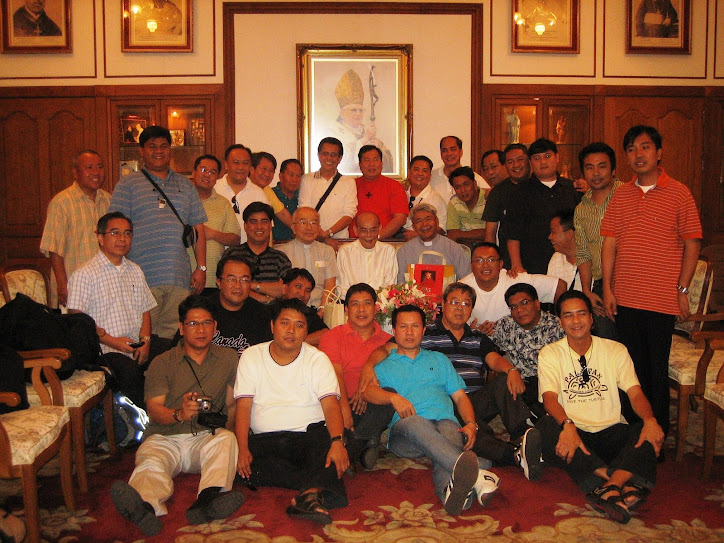
The clergy of Laoag with the lone cardinal of Thailand and the bishop of Changmai
Showing posts with label Opinion. Show all posts

MY ILOCOS MISSION EXPERIENCE, Dencio, CSsR

It has been one and a half year that I have been here in Ilocos Norte. My world seems to be full of juvenile realizations, as I journey towards new experiences of discovering this new attempt of the congregation to cross the borders of Ilocanos. The quest for learning and living keeps me going. Being new to this endeavour, the lure of fledging beginnings bring my enthusiasm to seek the faces of God from this new experiences with the people. My thirst for knowledge especially for the language is vindictive, thinking that someday I could talk fluently their language. Yet, along with the thirst of knowledge and difficulties, I am trying to immerse to what it seems to be different for me.

It is true that mission in Ilocos is different especially for a Tagalog speaking like me. I studied in the seminary for ten years but I was not even taught anything about the Ilocanos. Apparently, it just portrays how the colonial mentality sinks into our culture. We pay much on learning English language and other foreign languages but we do not even hire a teacher to teach us our own local languages. Nevertheless, I am learning from the people in the places where I have been out of their inner goodness and generosity. I would say that this is the fruit of immersion and living with the people that I am gaining incomparable discoveries even in the midst of a deplorable unknown.

What makes Ilocos different for me is that obviously one may put it in jest that they are genuine Ilocano in which I am not; more so, is my feeling that I am stranger with the culture and place. I think and feel that I am awakened with the pulsating new beat from the comfort of my simple upbringing. With regard to my first feeling, I longed to find a place to welcome my eloquence. Yet, true to what Stephen Bevans said, “bold humility” is a new attitude that is needed for a thorough reflection of my participation in mission. Sometimes, I just listen even though I don’t understand what people are conversing. I could not help but look at their faces expressing who they are. Once I thought, I wish I could speak their language well, so that I could utter more. Yet thanks, presence is really sacramental that it even reaches the language of relationship.

Since I arrived in Ilocos Norte, there were three places where I have been for mission and I got some common and distinct experiences from living with the people. Yet, I think my latter experience of mission which continues until now catches a little bit of my attention. It maybe because of how it opens my Catholic thinking into a more questioning and searching experience. The place is the farthest barangay of the parish. It is even harder to reach during rainy season because aside from muddy roads you also have to cross rivers. Maybe this is one of the reasons why some say Roman Catholic priests have found hard times visiting the place or even for other pastors to come and look after their flock. But, there are pastors from other denominations who just live nearby and even some are locals in the community. This is the reality for us anyway of representing the Roman Catholic faith among the rosters of different faith. We can be considered as strangers or minorities for they are originally baptized from their faith even before. Some denominations are moving fast in preaching and converting people due to the longing of the people for faith expressions or worst due to economic reasons. When we enter the place, there are more or less seven Roman Catholics. Just like the others, they are not even practising because very seldom or even not at all that they see a priest from the parish coming to say mass or even to visit them. They don’t even know their parish priest anyway or where the parish is situated. There was even one who said that Roman Catholics are just for the city dwellers. I remember during our initial days, we are even misconstrued as doctors who would get the vital organs of the children. So they were really hesitant to accept us.

Considering these realities, to get started was one of our problems when we entered. For me, I could not see myself at first celebrating mass with the people whom I know we don’t have the same exact faith expressions or rites. So, creating friendly relationship has been our ways to communicate our presence. Through the uneasiness in the initial building of relationship, my companions found hard times to find where we could eat and sleep in the community. Those were just our initial hardships and struggles of what it seemed to be striving attempt in the middle of indefinite upshot. We first forgot our modules which we are used to in doing missions. Some of us tried joining them planting in their rice field. We began to know also some signs on how the community works towards unity like in creating irrigation for their fields.

Then, I started to celebrate mass in the community to let them know also who we are and just to lessen their suspicions about us and our presence. We are also conscious that we need not ask them to come because of our differences. We could not help but communicate that our religion and theirs deal with respect. But things get confusing for me when they began to join us in masses and actively participate in the celebrations because I know they have their own rite. Knowing that most of them or even all of them were not Roman Catholics, I felt happy of their response but I also felt uncomfortable with the situations. I was thinking whether we were bringing them to us. Yet deeply, I could feel their sincere prayer even not spoken. One can be amazed how they sing glory to God in clapping hands though they sing not like the choir in the parishes with four voices in unison but everyone joyfully sings. Even sometimes others start ahead in singing and finish the song at different times but their hearts are singing beyond what is categorized as musical. One can also be amazed how men danced during the offering. I find our mass as truly a celebration. This is different for me because it is incomparable with the celebrations in the big parishes where people seem to be rigid or stiff that even not bowing properly or just forgetting something to what is prescribed seems to be a mortal sin. So I just leave my discomfort to God and relish the meaningful celebration of our praying together. My experiences taught me to make our faith simple, not bombarded by doctrines and rules that limit the deepest and simple expression of faith.
Moreover, as what I said my experience is full of juvenile realizations. Sometimes I could not help but listen to what people say about our diversities. It is just the same and they are comfortable that we are just one and that we just have one God that we worship. That’s why joining the mass is not anymore a problem for them. It shows that for them, differences don’t matter in worship. I think this is the same belief that leads them to accept a stranger and celebrate together in prayer. It is not so complicated. Maybe it would just be sad when each religion wave its flag to conquer the other as if they are the only one who knows about God. It will be more distressing when the pastors of every flock become the inhospitable agent of unity. I presuppose that this is one of the deepest problems of harmony when leaders become antagonists and possess unwelcoming hearts. Moreover, it is even unfair when a priest or a pastor puts priority on material gains rather than higher goals in sharing with the message of God. “Let us just leave our differences in religion to God.” This is what I learned from our seminar on Ecumenism. Let us not quarrel about it because we might just achieve it in the next life. As we were sharing in mission, we are reminded that if one provokes you for debate, just ask him or her to share a meal together whatever they may have in their homes.

Now, every time I go down to the city and some people ask about the mission I am telling the same realities. Some ask how many people have I converted now to Roman Catholic. But what conversion are they talking about? If what they mean is how many people have I baptized into Roman Catholic, sorry I failed. Yet, there are few who really wanted to be baptized so I did not refuse them. But I see from my experience with the people that conversion is more than baptizing to what faith you are bringing. It is a conversion that comes from an inner transformation. One thing that I shared to them in my homily was “if you are an Aglipayan now, for you to become converted, you must strive to be a good Aglipayan. If you are a member of Pentecostal, for you to become converted you must strive to be a good member of Pentecostal, or if you are a Roman Catholic, and you want to become converted, you must strive to be a good Roman Catholic. Just like saying if you are not welcoming before, for you to become converted, you must have a welcoming heart.” Or if you consider yourself as good and if you want to be converted, be a better person or even the best you are called to be. So I was brought back to my high school or even my elementary learning which pertains to the degree of comparison when I see conversion in the middle of these differences. This experience tells me that conversion is not about the number of baptism we have conducted but by the changes of heart from hatred to love, from rejection to acceptance or from disrespect to respect. We might think of ourselves as failures for not bringing more baptisms but conversion is gaining new understanding. This conversion of respect is what I have seen as we live with the people in this mission. That’s why, like the response of Bro. Edmund Chia to a sister who ask for help in their evangelization problem, I think we have to communicate to them that our religion or being a Roman Catholic is not one which aims to annihilate their religions, but one which seeks after truth and beauty no matter where and how that is expressed.

In our celebration now, we continue to welcome each other. My discomfort is also gone, my confusions of leading them into the mystery of Christ is left behind because I know that what we are celebrating is our friendship and the gift of faith that God has bestowed on us even in our diversities. In mission, the confrontation of divergences is always brazened out especially in faith and sometimes what divide people are the interpretations, traditional practices, doctrines, competition among religions and even the long unforgotten burden of historical quarrels within. But more to it is a dream to be united. We may be one as God and Jesus are one. What I have experienced with the people in mission is acceptance of life rather than religion. It is our goodness and fine intention that lead us to the celebration of life to whatever form we expressed.

I maybe too ambitious to dream of unity and new experiences but I just don’t want to carry the scarce of history that threatens the simplicity of faith of the people or even the common goodness of everyone. Let us think anew, celebrate differently, love respectfully and live meaningfully.

The bell has rung

Bells are often rung in church celebrations because they point to important events in the life of the Church. They are ‘awareness’ media, so to speak. Bells ringing in slow succession invite people to join the whole Church in praying for a dead Christian. Rapid ringing, on the other hand, invites people to join the whole Church in rejoicing with newly wed or christened brethren. Ringing during consecration announces the arrival of Jesus, the sacramental Lord, and alerts us of His most precious presence among us. Indeed, as one good priest said, bells are signs that the Church is alive.

But oftentimes the meanings of church bells are seldom understood, which is why they usually become ‘go signals’ for mechanical gestures rather than evocative symbols of authentic religious experience.

And while many Church members are unaware of the meanings of bells in the context of the liturgy, more perhaps are unaware of what bells ought to convey beyond liturgical life. For even if the Church may be perceived as alive because of meticulously prepared liturgy, this does not readily mean that the Church is pulsating with flesh and blood realities that bite not only a person’s conscience, but more importantly, the society’s consciousness.’

In these moments of moral, political and economic crisis, we should be alerted to the fact that bells -- it seems -- have not yet been significantly rung, nay audibly heard as a prophetic condemnation of socio-politico-economic evils such as multi-billion graft and corruption scams, jueteng, drugs, white slavery, 5/6, environmental destructions and dictatorship. As a Church, we examine ourselves: Have we exerted utmost effort to effectively carry out and sustain our prophetic role? Are our resolutions, pastoral letters and rallies enough? Have we renounced bankrupt structures and lifestyles that make the ‘haves’ richer and more luxurious, while the ‘have-not’ get poorer and more miserable? Are not these bankrupt structures and lifestyles some of the major factors that hinder the growth of a Basic Ecclesial Community (which, we believe, is one major solution to our crisis)? Answers to these questions (whoever gives the answer, be it the Magisterium, the theologian, the catechist or the simple farmer) must be scrutinized and weighed against the prevalence of evil and sin, especially the social ones -- the tree is judged according to its fruits.

In another viewpoint, we may also ask: Is it not the case that there are bells which cry against socio-politico-economic evils, but they simply land in the deaf ears and blank stares of indifferent, slumbering and complacent Christians? No matter, bells ought to be symbols which reflect flesh and blood realities. Accordingly, bells cannot unleash the full power of their symbolic capacity if they do not sing the cries of the poor and the oppressed who struggle each day to survive amidst factors of greed and injustice that push them even to intolerable levels of dehumanization. And while on this line of thought, it is good to remember that in certain contexts, justice-mercy-truth (the tripartite biblical concept which is the equivalent of the contemporary notion of social justice) constitutes the weightier matters of the law, and at times even weightier than worship (Cf. Mt. 9:13; 12:27; 23:23; Hos 6:6). In some sense, therefore, liturgical bells are less weighty than bells of activism. No wonder, Jesus had troubles with Jewish religious authorities because he preferred to promote life (and therefore social justice) than observe empty rituals (Cf. Mk 3:1-6).

Finally, we need to focus and work more on concrete realities than symbols. Symbols need not exist when reality is in place. Bells need not cry when we address real cries. For God, anyway, hears the cry of the poor and not the cry of bells. And how nice it will be when no one needs to cry because God has finally established His definitive Kingdom…with the Church’s effortful struggles to cooperate with God, of course.

Be that as it may, we make room for this post-script: For those who love bells and have made it their habit to live with bells ringing in their ears, bells may be sounded as symbols of jubilation in a society where God fully reigns. And so long as people hope, bells will ring. With strong conviction, commitment and authentic praxis, bells will ring differently until that time when all, in superlative jubilation, shall be with God and enjoy the blessings of total salvation in His Kingdom (that is, not only salvation from sin but also from any form of socio-politico-economic and ecological) evil…

…it is only then that the bell has truly rung…

Biblical insights on worsening national issues by Mr. Zacarias Damo, Jr.

(Mr. Zacarias Damo, Jr. graduated from San Pablo Major Seminary, Baguio City with a bachelor's degree in philosophy and finished two years of theological studies in ICST, Vigan City. While teaching at Divine Word College of Laoag, he happily works with the Diocesan Commission on Social Action.)

Issues abound anytime, anywhere, but the past few years have been so remarkable because of grave concerns like political killings, Jok-Jok Bolante, Hello Garci as well as the recent ZTE scandal and swine scam. As usual, the influential elite debate passionately on these. Ironically, they focus so much on legal and moral casuistry, while they (deliberately?) fail to significantly address the concrete needs of the common people, especially the poor majority.

Whatever motives they have, the battle among the elite of political, economic and even religious powers ultimately result in an even greater suffering of the poor majority or the so-called nagdurusang masa. No wonder, the CBCP does not subscribe to another people power. For in reality, it might be again a war of the elite (in the guise of people power) at the expense of the common people, especially the poorest. Indeed, after all is said and done, Yahweh’s ‘anawim (the biblical word for the nagdurusang masa, i.e., the poor and oppressed who have a special place in God’s heart) end up as the real losers.

The elite, of course, just lose positions in the struggle for power. But they never lose economic securities.

While the masa lose...

They lose what?

The masa by the way don’t have significant things to lose…for in the first place, they haven’t had enough. They only have much and many of the miseries that go with massive poverty. And (as one Catholic bishop puts it) massive poverty is the greatest scandal of the Church today.

The last sentence deserves much attention.

If we read again how the first Christians lived, we can find brothers and sisters who gathered together (i) to worship (ii) to break bread and (iii) to share belongings so that not a single Christian was in need (Cf. Acts 2:43-47; 4:32-37). From this passage, we can learn that the liturgical and sacramental dimensions of early Church life had concrete and tangible translations in the ordinary lives of believers, namely the sharing of belongings so that nobody was ever poor. Today we may call this as a politico-economic effect of liturgical and sacramental life. Liturgical and sacramental life, therefore, should primarily and necessarily influence our politico-economic affairs. This, indeed, ought to be an essential picture of authentic Christian spirituality.

The presence of massive poverty in our Christian societies, therefore, remains a most shameful reminder that we are still very far from the spirit of the early Christians…which is why, to repeat, massive poverty remains to be the greatest scandal of the Church today.

It is very appropriate to note also that, biblically speaking, the clearly spelled-out criterion for salvation is radical sharing of wealth by the rich with the poor. Read Mk 10: 17-27 where a rich man asked Jesus how to inherit eternal life (or salvation or Kingdom of God). Jesus, at first, mentioned the commandments, which the rich man proudly claimed to have observed since his childhood. But Jesus was not fully impressed. He stressed one weighty matter which the rich man had not fulfilled: the sale of his properties and the distribution of its proceeds to the poor. Commenting on the rich man’s failure to fulfill the challenge, Jesus said, “How hard it is for the rich to enter the Kingdom of God. It is even easier for a camel to pass through the eye of the needle than for the rich to enter the Kingdom of God.”

If only we understand fully, and are willing to be serious about it, we will see clearly that the Church has all the resources needed for religious, political and economic transformation. And, I think, the best avenue, the most conducive seedbed for change is the ecclesiological project called BEC (Basic Ecclesial Communities).

BECs, of course, need to be empowered by transformed individuals. Without personal transformation or conversion of its individual members, any social structure (even the Church at that), can never be a solid agent of change. No wonder, when Jesus preached the Kingdom of God, he clearly mentioned conversion as the believer’s appropriate response (Cf. Mk 1:14-15).

For now, most seem to understand BECs as avenues for liturgical and sacramental life. Consequently, we oftentimes cannot go beyond the concrete politico-economic effects of liturgy and sacraments, one of which is the eradication of massive poverty (as we have previously seen in the life of the first Christians).

History is candid about the scandalous reality that ever since humanity invented civilization, humanity has never overcome mass poverty. This leads me to doubt the truth of the claim that we are civilized. Why? Simple reason: civilization, I think, ought to secure and promote the well-being of all, and not that of the few. I guess, only when this happens can we proudly say that the Catholic Church has been very instrumental in the development of civilizations.

Greed resulting in massive poverty ought to be a heinous crime in a civilized society – and culprits must be easily and speedily tried and convicted. Unfortunately, culprits are on the loose, roaming around freely even as far as inside churches at times. (Perhaps, this prompted one archbishop to say that he will not give communion to public sinners).

Massive poverty seems to always prevail. Is it because those who influence human affairs are afraid? Of what? Of letting go of comfort, wealth and luxury zones they hold so dear? Of turning away from power zones they love to cling to? Of renouncing prestige zones they seem to cannot live without?

Many of us, the lay as well as the religious, are afraid to let go of the aforementioned zones. But it remains true that Jesus asked his disciples (and us) to deny the self (the greedy ego) if we wish to be his followers (Cf. Mk 8:34). Comfort, wealth, luxury, power and prestige zones are the core-vices of the old self, the ego that numbs the conscience, shuts the ears and leads the true self away from the transforming blows of the Holy Spirit.

‘Deny the Ego and live as God’s children! Give up the core-vices that make the rich richer and the poor poorer.’ This is an indispensable way to authentic Christian discipleship. It may not be the only way, but biblically speaking, it ought to be an inevitable way. Christian life is never complete without it. We may get rid of many incidentals with which we are comfortable. But radical sharing of wealth so that nobody shall be poor or in need (Cf. Deut. 15:4) is something without which Christian life can never be authentic.

We explore the gospel further: “If you wish to be my disciple, carry your cross and follow after me (Mk 8:34).” The cross of Jesus, before it was given a religious meaning, was the punishment of a rebel. Jesus openly went against the corrupt practices of the Jewish leaders (who happened to be priests, scribes or lawyers/religion teachers and wealthy business/landowners) and their Roman collaborators. Good for Jun Lozada today because he is quite protected by Church and political figures. Jesus had no such ‘kakampi’. Poor Jesus, therefore, ended up suffering on the cross, the most cruel punishment given to rebels (like Trillanes and Lim today).

How is it to carry the cross today?

First, it must be clarified that Jesus was not a political rebel, but he was branded so because he went against oppressive political, economic and religious structures. Yes, Jesus lambasted the core-vices of the ego, but he did so with a prophetic stance, which, in essence is that stand that zealously exposes and opposes all forms of evil (especially social injustice) in the spirit of non-violence and openness to forgiveness and reconciliation even with the worst sinner who sincerely repents and embraces conversion.

And that is how we ought to be today. As a Church, as a Christian nation, we must be prophetic. No matter how they brand us, we ought to work for holistic transformation. This, accordingly, necessarily leads us to a life of authentic freedom – in which we are very free to rub elbows with the elite as well as the pariahs of society, but when the situation calls for it, we are also fully free to expose and oppose their evil deeds…even if it would mean no more gifts and special privileges like free gadgets (such as computers and TV set), free cars (even luxury ones) free vacation abroad, free meals and free bus/airplane tickets.

The Church, in fairness, has been quite prophetic. So far, many pastoral statements have been proclaimed. But I think the Church’s prophetic teachings scribbled on social 9doctrine documents have not significantly trickled down to the consciousness and lifestyle of believers. Social/prophetic teachings are still the Church’s best kept secrets?

Also, can we not be more specific like Jesus when he frankly called Herod as fox (Lk 13:31-32) and the Jewish leaders as hypocrites (Mt 23:13), robbers (Mk 11:17) or brood of vipers (Mt 23:29-33) or even children of hell (Mt 23:15)? Biblical culture is not modern culture, you might say, but can we not be more faithful to the spirit of the prophetic tradition of boldness against injustice? …against unjust persons? … against specific unjust persons at that?

I find it odd at times when, in the TV, radio and newspaper, we appear to be very specific, vocal and influential when it comes to artificial contraceptives and pornography (while remaining silent about pornographic -- pirated, needless to say -- and abortifacient products sold even in front or within the immediate surroundings of churches), but cannot even publicly tell the Supreme Court to allow Neri to answer all questions of the senate because it is a crime against truth, and therefore against God, to conceal matters that directly or indirectly cause and aggravate the miseries of the poor.

Do we not believe that the whole truth (not half-truths) will set us free (Cf. Jn 8:31-34)?

No matter, Christian life or Church life should translate into the radical sharing exemplified by the first Christians.

Only then can we truly say that we have life to the full (Cf. Jn 10:10)!

Seeing Beyond the Controversy

Much ink has already been spilled on the issue of clerical “sexual” misappropriations. For a good number of times, this has been the dish of the broadsheets, and the broadsheets sold like hot potatoes. When the issue on Apo Bacani came up, it took the front page and was even the banner for a few days straight. The bishop “unwillingly” enjoyed a good share of airtime, too, on TV. And so he, who, I suppose, would be better known to the masa as the spiritual director of Velarde of the El Shaddai group, became a household name in an instant. The press, and mass media as a whole, has the power to do just that. It seizes people, noble or not, and uses them to spice up its otherwise dull papers, before it lets them go. Once they are let alone, breath would seem the only thing they have left. What’s a name without credibility? Good for them if they have no integrity to worry about. It’s really ironic to see how the press may disserve the truth. Noble people are killed before they are tried.

The wake of such clerical hitch usually sees the resurgence of the question whether priests should be allowed to marry, even as reasons for keeping to tradition, stretching from spiritual to practical, have time and again been presented. Abrogating the law on celibacy has often been put forward as the solution to the sexual misconducts of priests. Whose proposition? Mostly lay and a few clergymen. Like flaming liberals, these lay people who choose to see a non-celibate Catholic clergy forget that their priests chose to be celibate, in the first place. When they entered the priesthood, they knew full well the kind of life they were to live – a celibate life. And presumably they recognized its nobility and meaning, so they set their will to it. It’s the priests themselves who understand better than anybody else the whole import of celibacy to priestly ministry. I find it amusing, then, that the lay people should suggest “what would be good” to priests relative to their ministry. They are saying like, “I scratch your arm because it’s itchy.” Probably, they mean well. But I think they would be of better help if they just pray for their priests and create a nurturing atmosphere in which to do their ministry.

A study in the 1990's on American priests who have been 10 to 30 years in the ministry revealed that if they were to have a second shot at being a priest, they would choose to be celibate. If for some priests celibacy leads to a life of loneliness, the priests in the study attested that celibacy does not preclude warm friendships and intimate relationships. In fact, some of them even spoke of the freedom that celibacy gives them to have more such relationships than married couples. These relationships are the “I-Thou” kind, which enable them to be more effective, helping, enabling and loving. The priests I have come in contact with share the same sentiments. How, then, could the lay suggest, with a certain insistence, that the Catholic Church lift the celibacy law to solve the so-called clerical misappropriations? Of late, even an Aglipayan bishop figured in such sexual hitch, and he was very much married!

As a young cleric, I think there’s no better way to un-invite myself to such issue than choosing “to have a life.” I have to enjoy being a deacon, and being a priest later on, embracing the celibate life. I am convinced that being God’s minister is a significant way to spend my life, that what I do is important to the Church and to society. This conviction is sustained by a relationship with Jesus, by an active spiritual life involving prayer, scripture and liturgy. Looking at the days ahead, I will try to be authentic and form close relationships with my family and build a strong supporting network of priests. I will try to draw life from the people I serve, so that I will be able to serve them better. Listening first, I will allow my ministry to be characterized by service, compassion and empowerment. I will maintain a sense of balance and give myself a moment of repose. This is the life I see.(Rev. Tom, 2004)

CATECHETICAL AND MISSION OFFICE: Outreach in Adams, October 29, 2008

CATECHETICAL AND MISSION OFFICE: Diocesan Catechetical Day, September 20, 2008, Part 1 (2)

CATECHETICAL AND MISSION OFFICE: Diocesan Catechetical Day, September 20, 2008, Part 2 (2)

COM. ON THE CLERGY & OFF. ON CH. HERITAGE: Convocation (Playa Tropical, Currimao, Aug.18-20, 2008)